

What is Sri Vidya?
The Inner Journey from Divine Mother to Consciousness
What is Sri Vidya, and what does this ancient tradition actually teach?
Sri Vidya is a profound spiritual tradition centered on Sri Lalita Tripurasundari, Sri Chakra, Mantra Sadhana and the realization of the Divine Mother as the Supreme Reality. This comprehensive introduction explores the deeper philosophy of Sri Vidya — Shiva and Shakti, manifestation, Sri Chakra, Bahiryaga and Antaryaga, Kaula and Samaya, Bhoga and Moksha, and the inward journey from worship of the Divine Mother toward the recognition of Consciousness itself.
Drawing from the Upanishadic, Tantric and Agamic traditions, including the Lalita Sahasranama, Bhavana Upanishad, Tripura Rahasya and other important Sri Vidya sources, this study presents Sri Vidya not merely as Goddess worship or ritual, but as a complete path of Mantra, Yantra, Sadhana, contemplation and realization.
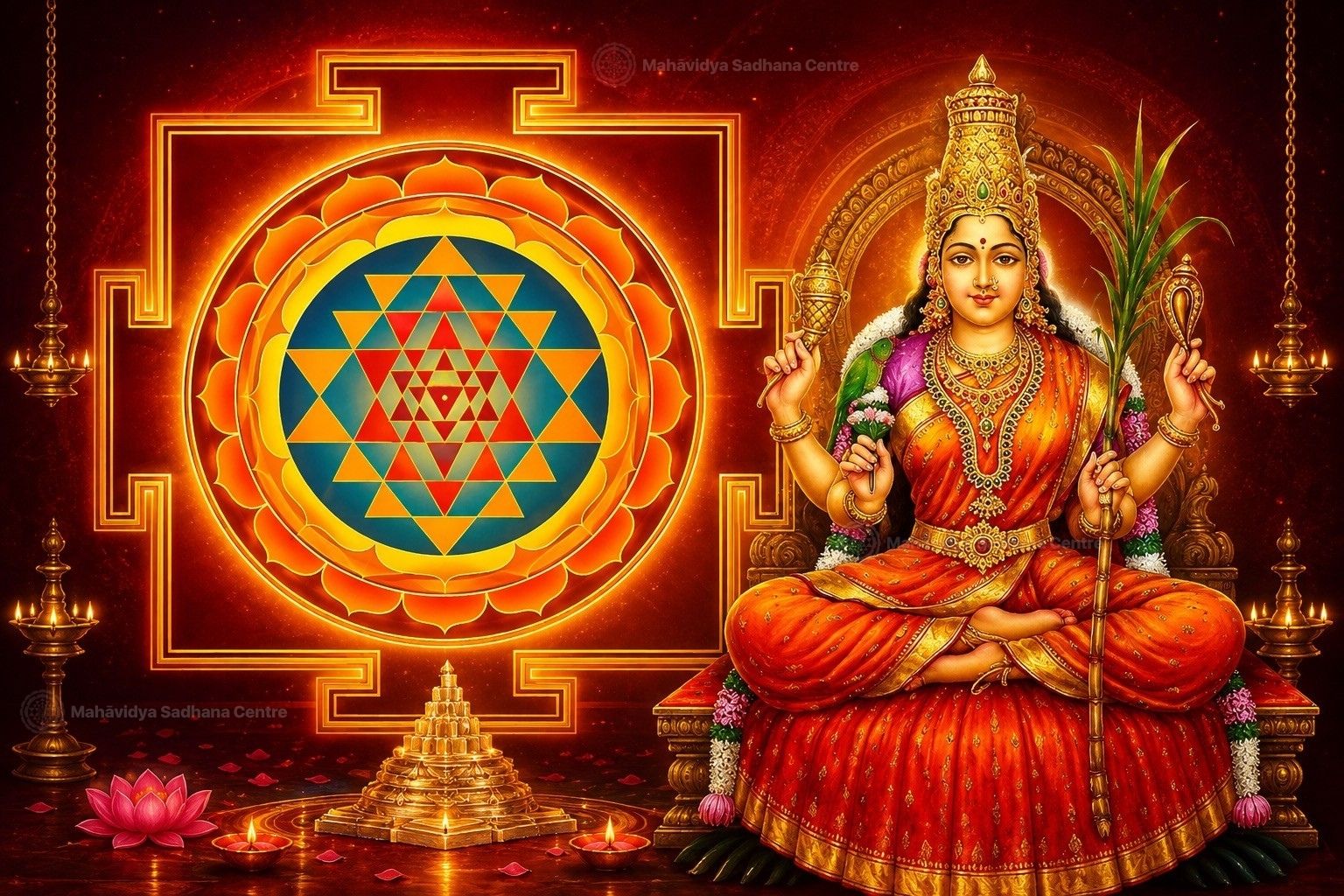
What is Sri Vidya?
Understanding Sri Vidya
- Why Is It Called Sri Vidya?
- Who Is the Divine Mother?
- Shiva and Shakti Are Not Two
- Shakti and Manifestation
- Why Is She Called Tripurasundari?
Sri Chakra and Sadhana
- Sri Chakra: How the One Appears as Many
- The Sri Chakra Within Us
- Mantra, Yantra and Devata
- Bahiryaga and Antaryaga
Paths and Philosophy of Sri Vidya
The Inner Journey
Scripture and the Essential Teaching
If someone asks, “What is Sri Vidya?”, the usual answer is that it is the worship of the Divine Mother, Sri Lalita Tripurasundari. That is correct, but it explains only how the journey begins. It does not tell us where Sri Vidya ultimately wants to take us.
Sri Vidya is an inquiry into three fundamental things: the Divine, the universe and ourselves. What is the source of this universe? What is the power through which it manifests? What is the consciousness through which we experience it? And if everything has arisen from one Supreme Reality, are we really separate from that Reality?
Sri Vidya approaches these questions through the Divine Mother. It gives us mantra, Sri Chakra, puja, contemplation and meditation. At first, these appear to be different ways of approaching Her. But as the sadhana deepens, the direction gradually changes. The Mother whom we were searching for outside begins to be discovered within, and eventually even the person who is searching has to be investigated.
We begin with the question, “Where is the Divine Mother?” Sri Vidya gradually leads us toward a much more profound question: “What is there that is not the Divine Mother?” Understanding this transition is perhaps the simplest way to begin understanding Sri Vidya.
Why Is It Called Sri Vidya?
Let us begin with the name itself. Vidya means knowledge, wisdom or knowing. Sri is much more difficult to translate with a single English word. It can indicate auspiciousness, beauty, abundance, radiance, sacredness and divine glory. In Sri Vidya, Sri ultimately points toward the Divine Mother herself.
The word Sri has a very deep history and meaning, which we have explored separately. Read: Sri — The Sacred Sound That Conceals the Mystery of Sri Vidya →
But there is another question worth asking. Why is this tradition called Sri Vidya? Why not simply Sri Puja or Sri Upasana? Because ultimately it is concerned with knowing.
We can perform a puja without understanding what the puja represents. We can repeat a mantra thousands of times without asking what that mantra is actually revealing. We can worship Sri Chakra for many years without understanding why its Bindu, triangles, lotuses and enclosures are arranged as they are.
Vidya asks us to go deeper. Who is the Devata being worshipped? What is mantra? What does Sri Chakra represent? Who is performing the worship? What is the relationship between the worshipper, the process of worship and the one being worshipped? When these questions begin to arise, worship gradually becomes Vidya.
Who Is the Divine Mother in Sri Vidya?
The central form of the Divine Mother in Sri Vidya is Sri Lalita Tripurasundari. She is worshipped as Sri Mata, Rajarajeshwari, Kameshwari and through many other names. The tradition describes Her beautiful form, Her throne, Her weapons, Her attendants and the extraordinary sacred universe surrounding Her.
All of this has meaning. But if we stop with Her form, we have understood only one level of Sri Vidya. Sri Vidya does not ultimately present Lalita merely as one Goddess among many Gods. She is the Supreme Shakti. To understand what this means, we must understand the relationship between Shiva and Shakti.
Shiva and Shakti Are Not Two
When Shiva and Shakti are shown in divine forms, it is natural for the mind to imagine two beings: Shiva as male and Shakti as female. This is useful at one level of worship, but the philosophy takes us much deeper.
Shiva represents Consciousness, while Shakti is the inherent power of Consciousness — the power through which there is awareness, will, knowledge, action and manifestation. We speak about them separately because the human mind understands through distinctions, but this conceptual distinction does not mean that two independent ultimate realities exist.
Can Consciousness really be separated from its power? Can fire be separated from its capacity to burn? We can distinguish between them for the purpose of understanding, but we cannot actually separate them.
The Lalita Sahasranama expresses this with extraordinary clarity in its final three names:
श्रीशिवा शिवशक्त्यैक्यरूपिणी ललिताम्बिका ॥
śrīśivā śivaśaktyaikyarūpiṇī lalitāmbikā
Sri Shiva — Shiva-Shaktyaikya-Rupini — Lalitambika
(Lalita Sahasranama, Names 998–1000)
The word aikya means unity, identity or oneness, while rupini means “She whose form or nature is.” Shiva-Shaktyaikya-Rupini therefore points to Lalita as She whose very nature is the oneness of Shiva and Shakti. The Sahasranama does not end by presenting the Divine Mother as a power standing apart from Shiva; it culminates in their unity.
This is fundamental to understanding Sri Vidya. Lalita is not simply Shakti standing beside Shiva. She is Shiva, She is Shakti, and She is their indivisible unity. Therefore, the Supreme Reality cannot ultimately be confined to male or female. In Sri Vidya, we approach that Reality as the Divine Mother and contemplate Her through a sacred feminine form, but the Reality to which that form points is beyond gender. The Lalita Sahasranama itself calls Her Parabrahma-svarupini — She whose very nature is Parabrahman.
Shakti and the Mystery of Manifestation
If Shiva and Shakti are inseparable, the next question naturally arises: what is this universe? Sri Vidya does not see Shakti merely as a power that created the universe at some distant point in the past. Shakti is the power through which manifestation itself becomes possible.
Traditionally, this power is contemplated in many ways. One very important triad is Iccha Shakti, Jnana Shakti and Kriya Shakti — the powers of will, knowledge and action. These should not be understood merely as three qualities possessed by a Goddess. They point toward fundamental dimensions through which Consciousness manifests and operates. We will encounter this triad again when we study the Trikona of Sri Chakra.
Now consider the implication. If this universe is the manifestation of Shakti, then creation cannot ultimately stand somewhere outside the Divine. The body belongs to this manifestation. The senses belong to it. The mind belongs to it. Our capacity to think, desire, know, create and act belongs to it. Even the person searching for the Divine exists within it.
So where exactly are we going to search for the Mother? Naturally, we begin outside. We go to a temple. We look at Her image. We worship Sri Chakra. We chant Her mantra and offer flowers. There is nothing inferior about this. It is a beautiful and important beginning.
But eventually Sri Vidya asks us to examine something much more carefully: If She has become everything, is the person worshipping Her also outside Her? That question changes the direction of sadhana.
Why Is She Called Tripurasundari?
The name Tripurasundari itself contains several layers of meaning. Different scriptures and traditions interpret Tripurathrough different triads, so it should not be reduced to one explanation alone.
One particularly profound meaning of Tripura concerns the three states through which our experience continuously moves: jagrat (जाग्रत्, jāgrat), waking; svapna (स्वप्न, svapna), dream; and sushupti (सुषुप्ति, suṣupti), deep sleep. The Tripura Rahasya identifies Parameshwari with the Consciousness underlying these three states and explains that She is therefore called Tripura.
In waking, an entire world appears. In dream, the waking world disappears and another world appears. In deep sleep, both disappear. Yet on waking we can say, “I slept well,” or “I did not sleep well.” This leads to a deeper inquiry: What is continuous through these changing states? What knows waking? What knows dream? What remains when the objects of waking and dream have disappeared?
The states change: the waking world appears and disappears, the dream world appears and disappears, and in deep sleep both are absent. Yet Consciousness is the underlying principle through which these changing states are known. Tripura therefore points not merely to “three cities,” but to the Divine Mother as the Consciousness present through all three states.
This is characteristic of Sri Vidya. We may begin with the form and name of the Mother, but if we follow them deeply enough, they begin revealing the nature of our own experience. The Goddess whom we first approach as the object of worship gradually leads us toward the very ground of the one who is worshipping.
Sri Chakra: How the One Appears as Many
There is another great question at the heart of Sri Vidya: How does the One appear as many? We speak of one Supreme Reality, yet our experience consists entirely of multiplicity — countless beings, objects, thoughts, forces and worlds.
Sri Vidya gives us an extraordinary way to contemplate this mystery through the Sri Chakra. At its center is the Bindu, the point of unity. Around it unfolds an increasingly complex geometry of triangles, lotuses, circles and enclosures extending toward the Bhupura.
The Sri Chakra can therefore be contemplated as a map of manifestation: from unity toward multiplicity, from the subtle toward the gross, from the One toward the many. But the sadhaka stands at the other end of this process. We already experience multiplicity. We experience ourselves as separate individuals surrounded by countless other things.
So the spiritual journey proceeds inward: from Bhupura through the Avaranas toward the Trikona and Bindu. This is why Sri Chakra should not be reduced to a prosperity symbol or an attractive piece of sacred geometry. It is a profound map of manifestation and, at the same time, a map of return.
Creation can be contemplated from the Bindu outward. Sadhana takes us from multiplicity back toward the Bindu.
The Sri Chakra Is Also Within Us
This is where the teaching becomes much more esoteric. Sri Chakra can be drawn, engraved, installed and worshipped externally. But Sri Vidya does not leave the Chakra on the altar.
The Bhavana Upanishad explicitly interprets the human constitution through Sri Chakra, identifying the body and its faculties with its sacred structure and giving particular importance to internal worship. The text even identifies Shakti with the inner Self.
This changes how we understand Sri Chakra. The Sri Chakra outside is not abandoned; it begins to reveal the Sri Chakra within. The body, senses, mind, energies and faculties of the sadhaka themselves become part of the sacred geography. Otherwise, it is possible to spend years worshipping the map without undertaking the journey represented by the map.
Mantra, Yantra and Devata
Sri Vidya approaches the same Reality through different doors. Through Devata, we approach through sacred form. Through Mantra, we approach through sacred sound. Through Yantra, especially Sri Chakra, we approach through sacred geometry. These are not three unrelated things.
The Lalita worshipped in divine form, the mantra through which She is invoked and the Sri Chakra through which She is contemplated are different modes of approaching the same Reality. This is why merely collecting mantras cannot be the purpose of Sri Vidya. Nor is the purpose to perform increasingly elaborate rituals simply because they are more elaborate. The important question is whether the practice is taking us deeper.
Initially we repeat the mantra. Later we begin to listen to it differently. Eventually another inquiry can arise: where does the mantra arise? Where does sound disappear? What knows the mantra while it is present? What knows the silence after the mantra has disappeared? Once again, Sri Vidya takes us from the object of experience toward its source.
Bahiryaga Must Become Antaryaga
This brings us to one of the most important principles in Sri Vidya: the movement from Bahiryaga, external worship, toward Antaryaga, internal worship.
In Bahiryaga there is an altar, a Sri Chakra, flowers, water, fragrance, light, mantra and the sadhaka performing the worship. These are not empty rituals. When properly understood, they create a sacred structure through which the sadhaka learns to approach the Devata. But the journey cannot remain entirely external.
At some point the question must arise: What does all this represent within me? The Sri Chakra begins to be contemplated internally. The Devatas acquire an inner significance. The offerings acquire an inner meaning. Ritual begins transforming the person performing the ritual.
The Bhavana Upanishad is particularly important here because it explicitly develops this inward vision of Sri Chakra and the human being. Eventually, even our ordinary distinction between “outside” and “inside” has to be questioned. If everything is Shakti, where exactly does outside end and inside begin?
Nigama and Agama
Sri Vidya stands within a very large scriptural world. Its development cannot be understood by reducing it either to “Vedic worship” or merely to “Tantra.”
Traditionally we encounter the broad categories of Nigama and Agama. Sri Vidya draws from the Vedic and Upanishadic world while its specialized mantra systems, Sri Chakra worship, ritual structures and contemplative methods are developed extensively within Tantric and Agamic traditions.
We should be precise here. This does not mean that the complete later system of Sri Vidya, exactly as practised today, can simply be found in the Vedas. Rather, there is a long scriptural development. Vedic literature gives us important antecedents concerning Sri, Vak, Devi, sacred sound and divine power. The Upanishadic world develops inquiry into Brahman, Atman and Consciousness. Shakta texts increasingly articulate the Supreme through the Goddess, while the Tantras and Agamas develop the distinctive mantras, Sri Chakra systems, rituals and internal practices of Sri Vidya in extraordinary detail.
In this sense, Sri Vidya stands at a remarkable meeting point of Nigama and Agama, knowledge and worship, philosophy and sadhana.
Kaula and Samaya
Within the history and practice of Sri Vidya we encounter several traditions and classifications. Kaula and Samaya are particularly important, but they are also frequently oversimplified.
One sometimes hears that Kaula means external worship for worldly benefits, while Samaya means internal meditation for liberation. This is not an adequate description of the historical traditions. Kaula traditions themselves contain sophisticated metaphysics and internal practices, and Samaya cannot simply be defined as “meditation.”
For an introductory understanding, there is a more important principle: whatever begins externally must eventually be understood internally. If I offer flowers externally but nothing within me changes, something essential has been missed. If I worship the Mother outside but never begin to recognize Her within, I have understood only one side of worship. If I worship Sri Chakra for years but never discover what it reveals about my own body, mind and consciousness, I have remained at its external form.
Therefore Bahiryaga must mature into Antaryaga. Some traditions begin with greater emphasis on external ritual; others emphasize internal contemplation. The terminology, practices and doctrinal classifications vary across texts and Guru Paramparas, and we should study those differences carefully rather than forcing them into a single scheme.
But the destination cannot be two different Truths. Whatever authentic path we follow, Sri Vidya ultimately brings us toward the recognition of the one Consciousness in which the distinction between Shiva and Shakti, worshipper and worshipped, external and internal, must finally be understood.
We will examine Kaula, Samaya, Dakshinachara, Vamachara and the different Sri Vidya traditions separately, because they deserve a proper article of their own.
What Does Sri Vidya Ask Us to Renounce?
This brings us to one of the most practical and beautiful aspects of Sri Vidya. Many Indian spiritual traditions have placed great importance on renunciation, and there are profound reasons for doing so. But Sri Vidya gives us another question to contemplate: If the Divine Mother has become this manifested universe, what exactly are we trying to renounce?
We cannot say that everything is Shakti and then treat the world itself as something spiritually impure from which we must escape. The real problem is not necessarily the world. The problem is our bondage to the world.
An object does not necessarily bind us; craving for it can. Money does not automatically bind us; greed, fear and the identity constructed around it can. A relationship need not be bondage; possessiveness, dependency and attachment can become bondage. Our experiences also leave impressions within us. These samskaras influence the way we perceive, desire, fear and react. We begin responding not simply to what is happening now but through everything we are carrying from the past.
Sri Vidya therefore turns renunciation inward. A person may leave home, give away possessions and withdraw from society while continuing to carry anger, fear, jealousy, pride and desire within the mind. Another may live with family, perform responsibilities, earn, create and participate fully in life while gradually becoming free from craving, possessiveness and identification.
Who is the greater renunciate? True renunciation is not merely having nothing. It is reaching a state in which nothing possesses you.
This is why the householder can have an important place in Sri Vidya. One does not necessarily have to escape manifestation to discover its source. One has to become free from bondage to manifestation.
Bhoga and Moksha
This also changes how we understand Bhoga and Moksha — experience and liberation. Sri Vidya should not be misunderstood as permission for indulgence. Uncontrolled desire creates samskaras and further bondage. But merely rejecting every pleasant experience does not automatically produce wisdom either.
The real question is more subtle: What is my relationship with experience? Can I enjoy something without becoming dependent upon it? Can I possess without becoming possessive? Can I love without turning love into ownership? Can I perform my responsibilities sincerely without making those roles my entire identity? Can I experience success without becoming success, and experience loss without losing myself?
This requires much greater awareness than simply declaring the world to be an obstacle. When craving, attachment and aversion are understood, life itself begins to become part of sadhana. The world has not changed. Our relationship with the world has changed.
What Is the Real Offering?
Now even puja begins to acquire another meaning. Initially we offer the Mother flowers, water, fragrance, food and light. These are sacred offerings and have an important place in traditional worship. But eventually we should ask ourselves: what does the Mother of the universe really need from me? Does She need my flower, or is the flower teaching me how to offer?
Perhaps there are deeper offerings: my anger, my fear, my pride, my jealousy, my attachments, my compulsions and the samskaras that repeatedly create bondage. Then puja is no longer merely something performed for the Mother. Puja begins transforming the person who performs it. The outer offering has begun to reveal the inner offering. Bahiryaga is beginning to become Antaryaga.
Who Is Actually Worshipping?
Every ordinary act of worship seems to contain three things: the worshipper, the process of worship and the one being worshipped. I offer a flower to Lalita. I am the worshipper, offering is the action, and Lalita is the worshipped. The three appear separate.
But now apply the principles we have already discussed. The flower belongs to Shakti. The hand offering it belongs to Shakti. The power moving the hand is Shakti. The mantra is Shakti. The capacity to remember and pronounce the mantra is Shakti. The mind contemplating Lalita operates through Shakti. The Devata receiving the worship is Shakti.
Then where exactly is this independent worshipper? This question should not be answered too quickly. Sri Vidya gives us sadhana precisely so that such questions gradually cease to be philosophical ideas and become matters of direct investigation.
From the Seen to the Seer
Suppose you are sitting before an image of Lalita. You see the Mother. Who is seeing?
We may say, “My eyes.” But close the eyes and Her form can still appear in memory. So seeing cannot be explained by the physical eyes alone. Perhaps the mind is seeing. But we can observe thoughts appearing and disappearing in the mind. We know when the mind is disturbed, and we know when it becomes quiet.
Then who knows the mind? Who knows that a thought has appeared? Who knows when it disappears? Who knows agitation? Who knows silence?
Now something remarkable has happened. The search for the Divine Mother and the inquiry into the nature of the seeker have begun to meet. The Mother whom we first searched for as something seen begins to lead us toward the mystery of the Seer. This is where Sri Vidya begins moving from worship toward realization.
Sri Vidya Is a Living Scriptural Tradition
None of this requires us to invent a modern mystical philosophy and call it Sri Vidya. Sri Vidya belongs to a large and sophisticated scriptural tradition. Its antecedents can be explored through Vedic conceptions of Sri, Vak, Devi, sacred sound and divine power; its philosophical world engages deeply with Upanishadic questions of Self and ultimate Reality; and its distinctive mantra, Sri Chakra, ritual and contemplative systems are developed through Shakta Tantric and Agamic traditions.
Important texts associated with the wider Sri Vidya tradition include the Bhavana Upanishad, Tripura Upanishad, Lalitopakhyana, Lalita Sahasranama, Tripura Rahasya, Vamakeshwara textual tradition, Nityashodashikarnava, Yogini Hridaya, Tantraraja Tantra, Jnanarnava Tantra, Parashurama Kalpa Sutra and Nityotsava, among others.
No single book contains everything that later came to be known as Sri Vidya. Nor does every lineage interpret or practise everything identically. Sri Vidya has developed through scriptures, commentaries, paddhatis and living Guru Paramparas.
This diversity does not weaken the tradition. It tells us that Sri Vidya is a living Vidya, developed and transmitted through different streams while repeatedly returning to certain central principles: the Divine Mother, Shiva-Shakti, mantra, Sri Chakra, the relationship between manifestation and Consciousness, and the movement from external worship toward inner realization.
Sri Vidya Has to Become Sadhana
There is one final point that is more important than knowing all these concepts. We can know a great deal about Sri Vidya without allowing Sri Vidya to change us.
We may know the nine Avaranas. We may recite Lalita Sahasranama beautifully. We may know many mantras, perform elaborate pujas and quote from Tantras. All of this can have value. But there is another test.
Has my anger reduced? Do I understand my fears better? Am I less controlled by attachment? Am I becoming aware of my samskaras instead of automatically acting through them? Is my mind becoming steadier? Has mantra become something more than sound? Has puja become something more than procedure? Is the distance between my spiritual practice and my ordinary life becoming smaller?
If nothing within us is changing, we may have accumulated a great deal of information about Sri Vidya without allowing the Vidya to transform us. This is why it is called sadhana. It has to be lived.
So, What Is Sri Vidya?
We can now return to the question with which we began. Sri Vidya is the worship of Sri Lalita Tripurasundari, but it is not merely Goddess worship. It contains mantra, but it is not merely repetition of mantra. It contains Sri Chakra worship, but it is not merely sacred geometry. It belongs deeply to Tantra, but it is not merely ritual. It contains devotion, meditation, contemplation and knowledge, but none of these individually defines Sri Vidya.
They are different doors through which the sadhaka approaches the same Reality.
We may begin with a simple understanding: “I am here, and the Mother is there.” Then we begin to recognize the universe as Her manifestation. Later we discover that Shakti is operating through our own body, senses and mind. Deeper still, we begin investigating the consciousness through which all of this is being experienced.
And eventually a much more difficult question appears: Who is this “I” that claims to be separate from Her?
This is where Sri Vidya reveals its deepest purpose. The One appears as many. Among the many arises a seeker searching for the One. Through mantra, Sri Chakra, worship, meditation, contemplation and knowledge, Sri Vidya gradually turns that seeker back toward the source.
We begin the journey asking, “Where is the Mother?”
And perhaps we begin to understand the Rahasya of Sri Vidya when the question changes to: “Where is She not?”
Further Reading
- Lalita Sahasranama,
- Bhavana Upanishad — for the internal contemplation of Sri Chakra and identification of its structures with the human constitution.
- Tripura Rahasya — especially its teachings concerning Tripura, consciousness and the three states of experience.
- Tripura Upanishad
- Yogini Hridaya
- Nityashodashikarnava
- Tantraraja Tantra
- Parashurama Kalpa Sutra
- Lalitopakhyana
- Nityotsava