

Sri
The Sacred Sound That Conceals the Mystery of Sri Vidya (Śrīvidyā)
What does Sri (Śrī) actually mean, and why is the tradition called Sri Vidya (Śrīvidyā)?
This comprehensive research article explores the Sanskrit meaning and etymology of Sri, the deeper Tantric and mantric meanings of Sri, Shreem (Śrīṃ) and Hreem (Hrīṃ), and their relationship with Bija Mantra, Matrika, Shakti, Shodashi and Sri Vidya. Drawing from primary scriptures and traditional commentaries — including Lakshmidhara, Bhaskararaya, Lakshmi Tantra, Devi Gita, Nityashodashikarnava and Mahanirvana Tantra — the study separates linguistic etymology from the deeper meanings revealed through Mantra Shastra and Sadhana. It is part of the ongoing research of Sukta Magazine and Publications, bringing together scattered scriptural teachings to develop a clear, authentic and comprehensive understanding of the sacred tradition of Sanatana Dharma.
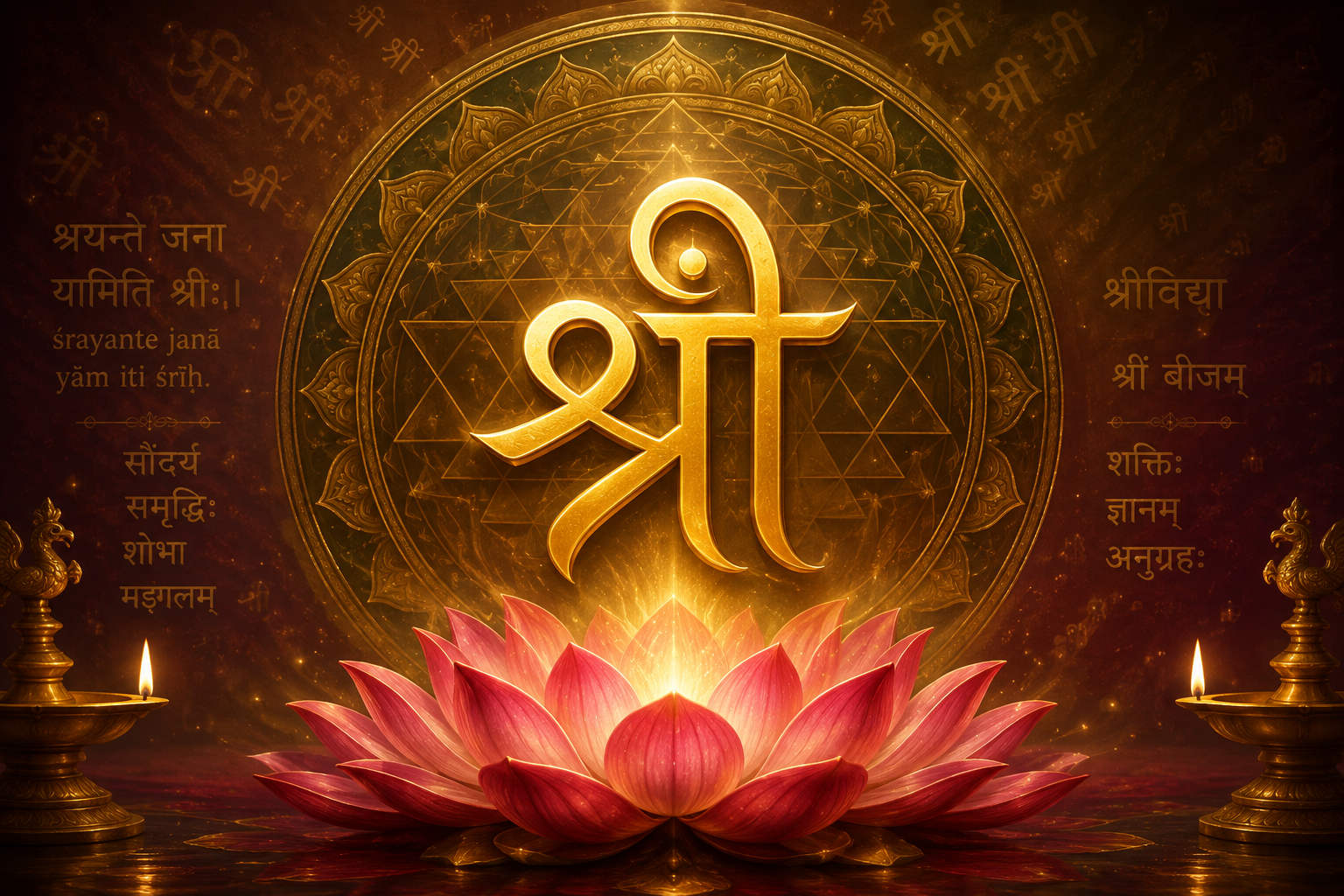
Sri: The Sacred Sound That Conceals the Mystery of Sri Vidya (Śrīvidyā)
There is a reason Bijaksharas (Bījākṣaras) were traditionally guarded with great care. In our tradition, we generally do not discuss their deeper meanings openly, not because the mantras are unavailable, but because availability is not the same as Adhikara (Adhikāra), and information is not the same as Vidya (Vidyā). A Bija is received through tradition, practised through Sadhana, and gradually understood through experience.
Yet I have repeatedly come across explanations of the word Sri from scholarly discussions and popular videos to teachings within Sri Vidya itself, that mix grammatical derivations, philosophical interpretations and mantric explanations without clearly distinguishing between them.
The word Sri (Śrī) is everywhere in the Sanatana Dharma (Sanātana Dharma) spiritual tradition.
We say Sri Rama, Sri Krishna, Sri Maha Lakshmi, Sri Devi, Sri Guru, Sri Chakra, Sri Yantra and Sri Vidya. It is placed before the names of deities, sacred texts, teachers and revered persons. In everyday understanding, Sri is associated with auspiciousness, prosperity, beauty and abundance.
But what exactly does Sri mean?
And more importantly, why is the spiritual tradition centered on Lalita Tripurasundari (Lalitā Tripurasundarī) called Sri Vidya (Śrīvidyā)?
The answer becomes much more interesting when we enter the world of Mantra Shastra (Mantra Śāstra).
To understand Sri properly, we need to look at it in two different ways.
First, we need to understand what Sri means in Sanskrit language and literature.
Then we need to understand what the sacred sound means in Sadhana, particularly in Tantra and Sri Vidya.
These are related, but they are not the same.
In Sanskrit literature, we ask:
What does the word Sri mean?
In Mantra Sadhana, we can ask a different question:
What do the sounds that constitute the sacred expression reveal?
This distinction is essential to understanding the deeper meaning of Sri.
The Sanskrit Meaning of Sri (Śrī)
In Sanskrit, Sri (Śrī — श्री) carries a remarkable range of meanings.
Among them are: radiance, splendour, beauty, grace, prosperity, abundance, excellence, dignity, glory and auspiciousness.
Sri is also intimately associated with Lakshmi Devi (Lakṣmī Devī), the Goddess who embodies prosperity, beauty, abundance and auspiciousness.
The word is traditionally connected with the Sanskrit verbal root shri (√śri), carrying senses such as resorting to, approaching, depending upon, taking refuge in, serving or honouring.
A traditional explanation beautifully expresses this dimension of Sri:
श्रयन्ते जना यामिति श्रीः
śrayante janā yām iti śrīḥ
“She in whom people take refuge is Sri.”
So even before we enter Tantra, Sri is not simply “wealth.”
Sri indicates a quality of radiance, fullness, beauty, excellence and auspicious abundance.
But when we enter Sadhana and Mantra Shastra, another dimension opens.
In Sadhana, Sound Itself Has Meaning
In ordinary language, letters form words, and words communicate meanings.
Mantra Shastra looks at sound differently.
A sacred mantra is not understood merely by looking up the dictionary meanings of its syllables. Its varna (varṇa) — its sounds and letters may themselves be contemplated as manifestations of particular powers, deities or principles.
This is part of the Tantric understanding of Matrika (Mātṛkā). The Sanskrit letters are traditionally known as Matrikas — the Mothers.
This is not merely poetic language. Within Tantric Sadhana, the alphabet is contemplated as a differentiated expression of Shakti (Śakti). The letters become the building blocks of mantra and articulated sound, and consequently play a profound role in the relationship between consciousness, thought, language, name and form.
This is why practices such as Matrika Nyasa (Mātṛkā-nyāsa) occupy an important place in Sri Vidya tradition.
Therefore, when a Sadhana text takes a sacred expression and separates it into its constituent sounds, we should understand what kind of interpretation is taking place.
It is not necessarily giving us the grammatical etymology of a Sanskrit word.
It is revealing its mantric structure or rahasya.
And this distinction completely changes the way we approach Sri.
The Mantric Secret of Sri
One of the most important explanations comes from Lakshmidhara (Lakṣmīdhara) in his commentary on the Saundarya Lahari (Saundaryalaharī).
While discussing the sixteenth Kala, Lakshmidhara writes:
षोडशी कला नाम शकार रेफ ईकार बिन्द्वन्तो मन्त्रः ।
ṣoḍaśī kalā nāma śakāra-repha-īkāra-bindvanto mantraḥ
The structure given here is:
Shakara (Śakāra) + Repha + Ikara (Īkāra) + Bindu
In sound:
Ś + R + Ī + ṃ
giving:
Shreem (Śrīṃ — श्रीं)
This is the Sri Bija (Śrī-bīja).
But Lakshmidhara does not stop there. He immediately makes an extraordinary statement:
एतस्यैव बीजस्य नाम श्रीविद्येति ।
etasyaiva bījasya nāma śrīvidyeti
and then:
श्रीबीजात्मिका विद्या श्रीविद्येति रहस्यम् ।
śrībījātmikā vidyā śrīvidyeti rahasyam.
The sense is:
“This very bija is called Sri Vidya. The Vidya whose nature is the Sri Bija is Sri Vidya—this is the secret.”
This is one of the most important statements for understanding why the tradition is called Sri Vidya.
We are no longer dealing merely with Sri as a Sanskrit word meaning prosperity or auspiciousness.
We have entered the language of Mantra Sadhana.
Sri has a mantric dimension.
And Lakshmidhara explicitly connects that dimension with Sri Vidya.
Sri and the Shodashi Kala (Ṣoḍaśī-kalā)
There is another important detail in Lakshmidhara’s statement.
He begins:
षोडशी कला नाम…
ṣoḍaśī kalā nāma…
“The sixteenth Kala is…”
and then gives the structure:
Ś + R + Ī + Bindu.
This places the Sri Bija within the profound Sri Vidya teaching of the sixteenth Kala.
The number sixteen has great importance in the tradition of Shodashi (Ṣoḍaśī). Lakshmidhara’s surrounding discussion speaks of the sixteen Nityas (Nityās), the lunar Kalas and the sixteenth principle.
He describes the sixteenth Kala as Chidrupa (Cidrūpā) — of the nature of consciousness and discusses its relationship with the other fifteen Kalas. So when he identifies Shreem with the Shodashi Kala, we are not dealing merely with a sound traditionally used for prosperity.
We are standing inside the mantra theology of Sri Vidya itself. This is one reason the Sri Bija must be understood much more deeply than its popular association with material wealth.
Is Sri Formed from “Shiva + Hri”?
This brings us to a widespread modern explanation. It is sometimes said that:
Sri is formed from Sha or Shi, representing Shiva, and Hri, representing Shakti.
From this it is concluded that Sri represents the union of Purusha and Prakriti, or Shiva and Shakti.
The philosophical intuition behind this explanation is understandable. Shiva-Shakti inseparability is indeed fundamental to Sri Vidya and to many Tantric traditions.
But we should not present this as the Sanskrit etymology of Sri.
Nor does Lakshmidhara give the mantric structure in that way. The structure he gives is:
Ś + R + Ī + Bindu
not:
Ś + Hrī
This becomes particularly important when we examine two famous bija mantras:
Hreem (Hrīṃ — ह्रीं)
and
Shreem (Śrīṃ — श्रीं).
Hreem and Shreem Are Related—but They Are Not the Same
Structurally:
Hreem (Hrīṃ)
H + R + Ī + ṃ
Shreem (Śrīṃ)
Ś + R + Ī + ṃ
They therefore share:
R + Ī + Bindu
while the initial consonant differs:
Ha in Hreem.
Sha in Shreem.
This is far more useful than saying vaguely that Sri contains Hri.
The two bijas possess a clear structural relationship, while remaining distinct mantras. And fortunately, we do not have to speculate about what these components can mean in Sri Vidya.
Bhaskararaya (Bhāskararāya) gives us an explicit interpretation.
Bhaskararaya Explains the Components of Hreem and Shreem
Bhaskararaya, one of the greatest authorities of the later Sri Vidya tradition, discusses these mantra components in his commentary on the Nityashodashikarnava (Nityāṣoḍaśikārṇava).
In one particularly important passage he explains:
शिवो हकारः ।
śivo hakāraḥ
“Ha is Shiva.”
He continues:
अग्निर्वह्निश्च रेफः ।
agnir vahniś ca rephaḥ
The Repha—the R sound—is Agni or Vahni, fire.
He then states:
माया तुर्यस्वरः ।
māyā turyasvaraḥ
The fourth vowel, Ī, is Maya (Māyā).
And Bindu is represented by the anusvara (anusvāra).
Thus the mantra structure yielding Hreem is explained through:
Ha — Shiva
Ra/Repha — Agni
Ī — Maya
Bindu/Anusvara — the concluding nasal point
But Bhaskararaya then does something especially important for our discussion.
In the same passage he explains another corresponding structure in which Shakara (Śakāra) appears, and explicitly says that the resulting pair of bijas is:
ह्रीं श्रीम्
Hreem and Shreem
which he describes as the Maya-Lakshmi (Māyā-Lakṣmī) pair.
This gives us a genuine textual relationship between Hreem and Shreem. We do not have to manufacture one.
Where, Then, Is Shiva in Hreem?
There is, however, another important textual connection that should not be overlooked. The Lakshmi Tantra (Lakṣmī Tantra), Chapter 25, while explaining the sacred correspondences of the Sanskrit letters, explicitly states “śakāraḥ śaṃkaraḥ” — “Shakara is Shankara.” The same chapter constructs Hreem (Hrīṃ) from Ha, Repha, Ī and Anusvara, and then teaches another form by replacing the initial Ha with Sha while retaining the remaining elements, producing Shreem (Śrīṃ). Thus, the association of Sha with Shankara does have an authentic Tantric precedent. What we should reject is not this symbolism, but the attempt to turn it into the grammatical equation “Sri = Shiva + Hri.” The Tantric symbolism is genuine; the linguistic etymology is a different matter.
This is where an important part of the popular explanation can be preserved — but correctly.
Bhaskararaya explicitly says:
शिवो हकारः
śivo hakāraḥ
“Ha is Shiva.”
So there really is a Shiva principle encoded in this particular Tantric analysis of Hreem.
But notice carefully:
He says Ha is Shiva.
He does not say that the Sha of Sri is Shiva in this passage.
That difference matters.
Therefore, if we wish to explain Shiva-Shakti symbolism through the mantra, we should use what the tradition actually gives us rather than changing the letters to fit a philosophical conclusion.
Sri Vidya does not need invented etymologies to establish Shiva-Shakti unity. Its scriptures contain far deeper teachings on that unity.
What Does Shreem Represent?
We should now return to Shreem (Śrīṃ) itself.
Lakshmidhara gives:
Shakara + Repha + Ikara + Bindu
and identifies this with the Shodashi Kala and Sri Vidya.
Bhaskararaya, in another Sri Vidya textual context, explicitly places Hreem and Shreem together as the Maya-Lakshmi (Māyā-Lakṣmī) pair.
This gives Shreem a much wider significance than the way it is often presented today.
In popular mantra literature, Shreem is frequently introduced simply as:
“the mantra for wealth.”
That is an enormous reduction.
Its association with Lakshmi Devi certainly explains its connection with prosperity, abundance and auspiciousness.
But Sri itself means far more than money, and the Sri Bija operates within a much deeper theological and mantric world.
Sri is splendour.
Sri is beauty.
Sri is auspiciousness.
Sri is abundance.
Sri is divine excellence.
Sri is Goddess.
And in the Sri Vidya interpretation preserved by Lakshmidhara, Sri Bija is connected with the sixteenth Kala and with Sri Vidya itself.
This is a much more complete understanding of Shreem.
Why Are the Letters Called Matrikas (Mātṛkās)?
To understand why Tantra gives such importance to individual sounds, we need to understand Matrika (Mātṛkā).
The Sanskrit word Matrika means a mother, little mother, or maternal power, depending on the context. In Tantric traditions, the Sanskrit letters themselves are known as Matrikas — the Mothers.
The idea behind this is profound. Mantras are formed from sounds. Words are formed from sounds. Names arise through sound, and the world as we know, distinguish and describe it is inseparable from nama-rupa (nāma-rūpa) — name and form. Tantra therefore does not look at the Sanskrit letters merely as characters written on paper, but contemplates them as powers of differentiated sound.
This is the larger framework in which Matrika Nyasa (Mātṛkā-nyāsa) becomes meaningful. The practitioner ritually places or contemplates these sacred letters within the body. And this is not merely a later philosophical interpretation; we find it directly expressed in Sadhana.
The Devi Gita (Devī Gītā) of the Devi Bhagavata Purana (Devī Bhāgavata Purāṇa) prescribes Matrika Nyasa and then Hrillekha Matrika Nyasa (Hṛllekhā Mātṛkā-nyāsa). In this practice, the constituent sounds associated with Hreem (Hrīṃ) are contemplated at specific locations in the body: Ha at the Muladhara (Mūlādhāra), Ra at the heart, Ī between the eyebrows, and Hreem at the crown of the head. This is particularly significant for our discussion because it shows that analyzing a Bija into its constituent sounds is not merely an intellectual exercise. The same understanding becomes part of Sadhana itself.
We find the larger principle again in the Mahanirvana Tantra (Mahānirvāṇa Tantra), Chapter 5, which prescribes Matrika Nyasa, discusses the sacred letters in terms of Bija and Shakti, and places the Sanskrit alphabet within the Chakras and upon different parts of the body.
The body is therefore no longer viewed as something spiritually separate from mantra. The sounds of the mantra, the Matrikas, the body of the Sadhaka and the Shakti being worshipped are gradually contemplated as expressions of the same underlying reality.
This reveals one of the profound movements of Tantric Sadhana:
What is first worshipped outside is gradually discovered within.
Sound and Manifestation in Sri Vidya
Tantric traditions contain sophisticated and sometimes differing accounts of how consciousness, Shakti, sound and manifestation are related.
Therefore, we should be careful not to impose one simplified sequence upon every Tantra.
But the broader principle is clear:
sound occupies an extraordinary position between consciousness and articulated manifestation.
At increasingly differentiated levels we encounter ideas such as:
Shakti (Śakti)
Nada (Nāda)
Bindu
Varna (Varṇa)
Mantra
Nama-Rupa (Nāma-Rūpa)
Different scriptures arrange and interpret these principles according to their own doctrinal systems.
What matters for our present discussion is this:
Mantra is not treated merely as ordinary speech.
The mantra is a subtle expression of the deity and her Shakti.
This is why understanding a bija requires more than translating it.
A bija is not merely a shortened Sanskrit word.
It is a mantric concentration of meaning and power.
What Does Vidya (Vidyā) Mean in Sri Vidya?
We have examined Sri.
Now we need to examine Vidya.
In ordinary Sanskrit, Vidya (Vidyā) means knowledge, learning, understanding or wisdom.
Therefore, translating Sri Vidya as “knowledge of Sri” is not wrong.
But it is incomplete.
In Tantric usage, Vidya can also refer to a sacred mantra, especially a mantra associated with a Goddess (feminine).
This is crucial.
A mantra does not merely give information about a deity.
Within Mantra Shastra, mantra and deity have an intimate identity. The mantra can be understood as the deity’s mantra-svarupa (mantra-svarūpa) — her form as sacred sound.
This gives Lakshmidhara’s statement extraordinary importance:
श्रीबीजात्मिका विद्या श्रीविद्येति रहस्यम् ।
“The Vidya whose nature is the Sri Bija is Sri Vidya—this is the secret.”
Sri Vidya therefore need not be understood merely as an intellectual body of “knowledge about the Goddess.”
It is Vidya as knowledge.
It is Vidya as mantra.
It is Vidya as Sadhana.
And ultimately it is a means through which Sri — the Divine Mother — is known through direct spiritual realization.
Sri, Hreem and Shreem: The Essential Distinction
We can now make the distinction very clearly.
Term | Structure / Type | Meaning in this discussion |
Sri (Śrī) | Sanskrit word | Radiance, splendour, beauty, prosperity, abundance, excellence and auspiciousness; also a sacred name of the Divine Feminine |
Hreem (Hrīṃ) | Ha + Ra + Ī + Bindu | A major Shakta Bija; in Bhaskararaya’s explanation, Ha = Shiva, Repha = Agni, Ī = Maya |
Shreem (Śrīṃ) | Sha + Ra + Ī + Bindu | The Sri Bija; Lakshmidhara connects it with the Shodashi Kala and Sri Vidya |
The essential point is:
Sri is not Hreem. Hreem is not Shreem. And Shreem is not simply the ordinary Sanskrit word Sri.
They are closely related within the language of Mantra Shastra, but each belongs to a different linguistic or mantric context.
Three Ways of Understanding Sri
At this point, three different methods of interpretation become clear.
1. Vyutpatti — Linguistic Derivation
This asks:
Where does the Sanskrit word come from?
Here we study the Sanskrit root, grammar and established meanings of Sri.
2. Nirvacana — Interpretive or Theological Explanation
Traditional texts may unfold additional meanings from a sacred word, connecting it with theological ideas.
This is not necessarily the same thing as grammatical derivation.
It is a traditional way of revealing meaning within a sacred name.
3. Mantrartha or Rahasya (Mantrārtha/Rahasya) — Mantric Meaning
This asks:
What do the sounds themselves reveal within Sadhana?
Here we encounter:
Shakara
Repha
Ikara
Bindu
and their relationships with divine principles.
This third approach is especially important for understanding Sri in Sri Vidya.
Confusion arises when these three methods are mixed together and presented as though they were one grammatical etymology.
Once we separate them, the subject becomes much clearer.
So What Does Sri Really Mean in Sri Vidya?
We can now return to the question with which we began.
What is Sri?
At the level of Sanskrit language, Sri conveys radiance, splendour, beauty, prosperity, abundance, excellence and auspiciousness.
At the theological level, Sri is associated with the Goddess and Divine Feminine.
At the level of Mantra Sadhana, we encounter Sri Bija—Shreem:
Ś + R + Ī + Bindu
and Lakshmidhara explicitly identifies this with the Shodashi Kala and connects it with Sri Vidya.
At another level of Sri Vidya mantra interpretation, Bhaskararaya shows us how individual sounds can themselves signify profound principles such as Shiva, Agni and Maya, and he places Hreem and Shreem together as the Maya-Lakshmi pair.
We therefore begin to see why a simple English translation can never completely capture Sri.
Sri is not merely wealth.
Sri is not merely good fortune.
Sri is not merely an honorific placed before a name.
And Sri should not be explained through the unsupported formula “Sha/Si + Hri = Shiva + Shakti.”
The authentic tradition gives us something much richer.
Sri is radiance.
Sri is beauty.
Sri is fullness and auspicious abundance.
Sri is Goddess.
And in the inner language of Sri Vidya Sadhana, Sri becomes Bija, Kala and Vidya.
This is where the name Sri Vidya begins to reveal its depth.
The Deeper Vision of Sri Vidya
Sri Vidya ultimately asks the Sadhaka to make a profound shift in understanding.
The Divine Mother is not merely a deity somewhere outside the universe.
The universe itself is her manifestation.
In the inner vision of Sri Vidya, the consciousness by which the universe is known is itself inseparable from Shakti.
The power by which consciousness becomes thought, sound, name and form is Shakti.
Therefore, mantra is not merely a prayer spoken to the Divine Mother.
At a deeper level of Sadhana, mantra becomes a means of recognizing the Divine Mother as the very power of consciousness within oneself.
This is why the movement of Sri Vidya is simultaneously outward and inward.
The Sadhaka worships Devi outside.
The Sadhaka invokes her through mantra.
The Sadhaka discovers the same Shakti within.
And gradually the separation between:
the worshipper,
the act of worship,
and
the One being worshipped
is examined at increasingly subtle levels.
Sri Vidya therefore cannot finally be reduced to the worship of a particular external form.
Nor can it be reduced to philosophy alone.
It is a Vidya — a knowledge.
It is a Mantra Vidya — a sacred science of mantra.
It is a Sadhana — a path of practice.
And it culminates in recognition.
The Divine Mother whom the Sadhaka first approaches as Sri is ultimately discovered as the very Shakti through which consciousness, the Sadhaka and the universe itself appear.
This is the most beautiful way to understand the name:
Sri Vidya is the Vidya through which Sri is known.
Not merely known intellectually.
Not merely worshipped externally.
But gradually recognized as the radiant Divine Reality manifesting within and as all existence.
That is the deeper mystery contained in the name Sri Vidya.
Principal Scriptural and Traditional Sources
1. Saundarya Lahari (Saundaryalaharī) with the Commentary of Lakshmidhara (Lakṣmīdhara)
This is the central source for the argument of this article.
Lakshmidhara explicitly gives:
षोडशी कला नाम शकार रेफ ईकार बिन्द्वन्तो मन्त्रः ।
and continues:
एतस्यैव बीजस्य नाम श्रीविद्येति । श्रीबीजात्मिका विद्या श्रीविद्येति रहस्यम् ।
This directly establishes the relationship between Shakara + Repha + Ikara + Bindu, the Shodashi Kala, Sri Bija, and Sri Vidya.
2. Nityashodashikarnava (Nityāṣoḍaśikārṇava) with Bhaskararaya’s (Bhāskararāya) Commentary
This provides an especially important mantric analysis:
शिवो हकारः ।
“Ha is Shiva.”
अग्निर्वह्निश्च रेफः ।
“Repha is Agni/Vahni.”
माया तुर्यस्वरः ।
“The fourth vowel [Ī] is Maya.”
The commentary then identifies the resulting pair as Hreem and Shreem, the Maya-Lakshmi pair.
This is an exceptionally useful textual basis for understanding the relationship between the two bijas without inventing a false etymology for Sri.
3. Ahirbudhnya Samhita (Ahirbudhnya Saṃhitā)
The Ahirbudhnya Samhita preserves traditional theological explanations of the name Sri through verbal forms such as śrīyate and śrayate. Such passages are valuable for distinguishing nirvacana, or theological interpretation, from strict grammatical derivation.
4. The Matrika and Mantra Shastra Traditions
Shakta and Tantric traditions extensively develop the understanding of Sanskrit letters as Matrikas and employ letter-by-letter analysis in mantra interpretation.
The precise meaning assigned to an individual letter, however, can vary according to text, mantra and lineage. For this reason, a correspondence found in one scripture should not automatically be declared the universal meaning of that letter throughout Tantra.
A Final Note on Authenticity
When studying Sri Vidya, we should allow the scriptures to speak in their own language.
If a text gives a grammatical derivation, we should call it grammatical derivation.
If it gives a nirvacana, we should call it a theological or interpretive explanation.
If it analyzes Shakara, Repha, Ikara and Bindu, we should recognize that we have entered the language of Mantra Shastra and Sadhana.
We do not need to mix these different levels in order to make Sri Vidya appear profound.
The authentic teaching is already profound.
Sri is a word in Sanskrit. Sri is a name of the Divine Mother. Shreem is a Bija. And in the Rahasya of Sri Vidya, these worlds of language, mantra, Devi and consciousness begin to meet.
This is where the name Sri Vidya begins to reveal its inner meaning, the Vidya through which Sri is known.
Sri Matre Namaha.
~ Sri Chaitanya
Principal Scriptural and Traditional References
1. Saundarya Lahari (Saundaryalaharī), with the commentary of Lakshmidhara (Lakṣmīdhara)
The principal source used here for the identification of Shakara + Repha + Ikara + Bindu with the Shodashi Kala, and for the declaration “śrībījātmikā vidyā śrīvidyeti rahasyam.”
2. Nityashodashikarnava (Nityāṣoḍaśikārṇava), with the commentary of Bhaskararaya (Bhāskararāya)
3. Lakshmi Tantra (Lakṣmī Tantra)
Gives individual letter correspondences “śakāraḥ śaṃkaraḥ”, constructs Hreem from its constituent elements, and explains the corresponding construction of Shreem as Anutarika.
4. Ahirbudhnya Samhita (Ahirbudhnya Saṃhitā
Traditional nirvacana of Sri, through verbal forms such as śrīyate, śrayate, śṛṇāti and śrīṇāti. This helps distinguish theological interpretation from grammatical derivation.
5. Devi Bhagavata Purana (Devī Bhāgavata Purāṇa) Book VII
A valuable source for Matrika Nyasa and Hrillekha Matrika Nyasa.
6. Mahanirvana Tantra (Mahānirvāṇa Tantra), Chapter 5.
Provides an explicit description of Matrika Nyasa
7. Sri Vidyarnava Tantra (Śrīvidyārṇava Tantra)
An important Sri Vidya ritual compendium containing extensive traditions of Nyasa and Matrika Nyasa.
Important Secondary Studies
8. Sir John Woodroffe (Arthur Avalon), The Garland of Letters (Varnamālā)
One of the modern studies of Shabda, Matrika, Varna, Bija, Mantra, Shakti and the stages of sound.
9. Douglas Renfrew Brooks, Auspicious Wisdom: The Texts and Traditions of Śrīvidyā Śākta Tantrism in South India(SUNY Press, 1992)
Note: Many additional scriptures, traditional commentaries, books, and scholarly works were consulted in the preparation of this research article. The references listed above are those most directly relevant to the principal points discussed.
Research Note: This article forms part of the ongoing research undertaken by Sukta Magazine and Publications into the scriptures, philosophy, Mantra Shastra and Sadhana traditions of Sri Vidya. The primary published version of this research is available on Mahaavidya.org.