

What Is Sri Chakra?
The Sacred Geometry of Lalita Tripurasundari, the Universe, and the Journey Back to the Bindu
Sri Chakra can be seen in a moment, yet its mystery can unfold over an entire lifetime of Sadhana. At its center is a single Bindu, and from that silent point emerges an astonishing universe of triangles, lotuses and sacred enclosures. The Tantras reveal that this is not merely geometry: Sri Chakra is Lalita Tripurasundari, the universe, the human being, and the hidden journey of consciousness itself. To travel from Bindu outward is to contemplate how the One becomes the many; to journey from Bhupura back to Bindu is to enter the path of the Sadhaka. And somewhere within that journey lies the great secret of Sri Vidya: the center we are searching for was never absent.
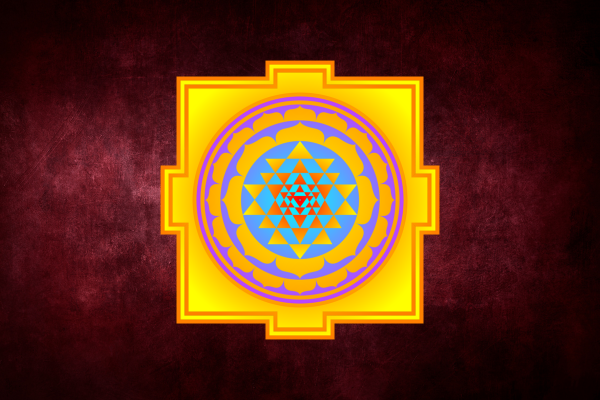
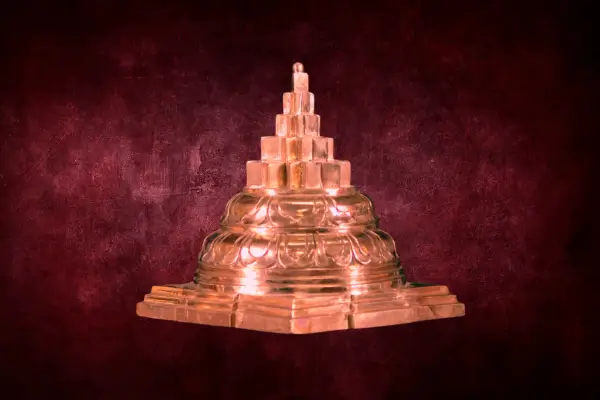
Sri Chakta - Where Sacred Geometry Becomes a Map of Consciousness
There are aspects of Sri Chakra (Śrīcakra) that anyone can see. Its outer square can be drawn. Its lotuses can be counted. Its triangles can be measured. The nine enclosures can be named, and the mysterious point at its center can be identified as the Bindu.
But seeing Sri Chakra is not the same as understanding Sri Chakra.
In Sri Vidya (Śrīvidyā), the visible diagram is only the beginning. Behind every line lies a doctrine; behind every enclosure, a field of Sadhana; behind every triangle, a relationship between consciousness and manifestation. Sri Chakra brings together Devi, Mantra, Yantra, Tantra, the human body, the universe, the powers of perception, the processes of manifestation, and finally the very consciousness by which all of them are known.
This is why Sri Chakra can never be exhausted by a diagram or a table of correspondences. A person can learn its external geometry in a day and spend a lifetime entering its inner meaning.
Its nine enclosures are called the Nava Avaranas (Navāvaraṇas). We can describe their external forms, but an Avarana is not merely a geometrical enclosure. In Sri Vidya Sadhana, each Avarana opens into its own world of Devatas, Shaktis, Mantras, Mudras, Tattvas, powers and Bhavana.
In that sense, each Avarana is itself a Sadhana. Its deeper meaning is not revealed simply by collecting information about it. It unfolds progressively through Diksha (Dīkṣā), Krama, Upasana (Upāsanā), Bhavana (Bhāvanā) and Sadhana (Sādhanā). This article therefore explains what can be understood openly about Sri Chakra while allowing its deeper Rahasyas to remain where the tradition places them — within Sadhana.
The geometry can be shown openly. The journey hidden within it must be lived.
The Hidden Architecture
- The Sacred Geometry of Sri Chakra
- The Two Journeys Hidden in Sri Chakra
- The Nine Avaranas of Sri Chakra
- Sri Chakra as the Body of Lalita Tripurasundari
- From External Worship to the Inner Sri Chakra
- The Mystery of Manifestation and Return
- Sri Chakra as a Map of the Universe and Human Being
- The Rahasya of Sri Chakra
- So What Is Sri Chakra?
The Sacred Geometry of Sri Chakra
Sri Chakra Is Not Merely a Diagram
The Sanskrit word Chakra (Cakra) commonly means a wheel, but in the Tantric context its significance extends beyond a circular object. A Chakra is an ordered arrangement in which many parts belong to and function within a greater whole.
This is particularly important when looking at Sri Chakra. At first our eyes notice individual things: a square, petals, triangles, circles and a point. But none of these exists independently. Every part receives meaning through its relationship with the rest of the structure, and the entire structure remains oriented toward one center.
Sri Chakra is therefore not simply a collection of sacred shapes. It is an ordered universe. And this universe has a center.
Everything Begins at the Bindu
At the very heart of Sri Chakra is Bindu — a point.
In an ordinary drawing, a dot has size because ink occupies space. But geometrically, an ideal point has position without measurable length, breadth or area. It appears to be almost nothing, yet it establishes the center from which the rest of the structure becomes intelligible.
Sri Vidya places its highest mystery precisely here. The Bindu represents the transcendental center around which the entire Sri Chakra unfolds. The increasingly differentiated geometry of Sri Chakra can therefore be contemplated as the manifestation of what is held in complete unity at the center.
This reverses the way we ordinarily look at the Yantra. The Bindu appears to be the smallest feature in the entire diagram, while the outer Chakra appears vast and complex. Yet spiritually the relationship is almost the opposite: the apparently smallest point contains the principle around which everything else is ordered.
The outer structure is not greater than Bindu merely because it occupies more space. The entire structure has unfolded around the center.
From the One Comes the Three
Immediately around Bindu lies the innermost Trikona, the downward-pointing triangle.
A point expresses unity. A triangle introduces threefoldness. The One has not disappeared, but differentiation has begun.
Traditional Sri Vidya does not limit this Trikona to one single interpretation. Its three corners are contemplated through several sacred triads. They are associated with Kameshwari, Vajreshwari and Bhagamalini; with the processes of Srishti, Sthiti and Samhara — creation, preservation and dissolution; and with the three Kutas of the Panchadashi Mantra. The triangle also enters the profound mystery of Kamakala (Kāmakalā).
At another level, threefoldness appears as Iccha, Jnana and Kriya Shakti — the powers of will, knowledge and action.
This teaches us something essential about Tantric symbolism. One sacred form may reveal several interconnected meanings. The Trikona is not a geometrical object with one dictionary definition. It is a field through which different dimensions of the same Reality can be contemplated.
The Trikona is the first great opening of unity into threefoldness.
From Three to Nine
Beyond the innermost triangle lies the extraordinary geometry for which Sri Chakra is famous: nine principal interpenetrating triangles.
The most widely transmitted interpretation understands them as four Shiva triangles and five Shakti triangles. Through their mutual intersection emerges the celebrated field of forty-three smaller triangles.
But the important word here is not merely triangle. It is interpenetration.
These triangles do not simply sit next to one another. They enter one another, create new intersections through one another, and become part of a single geometrical body. Traditional discussions speak of Sandhis, where lines meet, and Marma-sthanas, where multiple lines intersect, expressing the profound principle of Samarasya — the harmony or inseparable union of Shiva and Shakti.
Shiva and Shakti should not be understood here merely as a male deity and a female deity occupying opposite parts of the diagram. At the deeper Tantric level, Shiva points toward consciousness, while Shakti is consciousness as power, self-revelation, movement and manifestation.
Fire cannot be separated from its capacity to burn. Light cannot be separated from illumination. In the same way, consciousness cannot finally be separated from its power.
Shiva and Shakti do not merely meet inside Sri Chakra. Their meeting becomes the geometry of Sri Chakra.
The Mystery of 1, 3, 9 and 43
There is a simple way to begin seeing the unfolding geometry: 1 — Bindu, the center and unity; 3 — Trikona, the emergence of fundamental threefoldness; 9 — the principal triangles, the interpenetrating field of Shiva and Shakti; and 43 — the differentiated triangular universe.
Beyond these appear the eight-petalled lotus, the sixteen-petalled lotus, the circular boundaries and finally the Bhupura.
This sequence should not be mistaken for a claim that every ancient Sri Vidya scripture formally teaches a mathematical cosmology of 1, 3, 9 and 43. It is a contemplative way of reading the actual geometry in light of the traditional understanding of Srishti.
But it reveals something remarkable: complexity emerges without losing the center. The geometry becomes increasingly elaborate. Forms multiply. Intersections multiply. Yet Bindu remains.
The universe may appear as unimaginable multiplicity, but the source has not therefore disappeared.
The Two Journeys Hidden in Sri Chakra
There are two fundamental ways of moving through Sri Chakra. One begins at the Bindu and moves outward. The other begins at Bhupura and moves inward.
From Bindu to Bhupura
The outward movement is traditionally connected with Srishti Krama, the order of manifestation. Unity becomes progressively differentiated until the sacred geometry reaches the outer field.
Bindu to Bhupura is the mystery of the One appearing as many.
From Bhupura to Bindu
The inward movement is associated with Samhara, Laya or Aroha — the gathering of multiplicity back toward the central principle. This is the direction especially relevant to the inward journey of the Sadhaka.
Bhupura to Bindu is the mystery of the many returning toward the One.
The same Yantra therefore contains both movements: the unfolding and the return.
The Nine Avaranas of Sri Chakra
Sri Chakra is approached through Nava Avarana — nine sacred enclosures or circuits. From outside toward the center they are:
Bhupura — Trailokya Mohana Chakra
Shodasha-dala — Sarvasha Paripuraka Chakra
Ashta-dala — Sarva Samkshobhana Chakra
Chaturdashara — Sarva Saubhagya Dayaka Chakra
Bahir Dashara — Sarvartha Sadhaka Chakra
Antar Dashara — Sarva Rakshakara Chakra
Ashtakona — Sarva Rogahara Chakra
Trikona — Sarva Siddhiprada Chakra
Bindu — Sarvanandamaya Chakra
Externally, these nine Avaranas are easy to identify. Internally, they are enormous.
Each Avarana has its own Chakreshwari, Yoginis, Shaktis, Mudras, Mantric associations and inner significance. Their meanings cannot be reduced to nine convenient one-line definitions.
An Avarana is not merely a symbol. An Avarana is a Sadhana.
A person can learn the names of all nine in a few minutes. The deeper meaning of even one Avarana may unfold through years of practice. This is why traditional Sri Vidya places great importance upon Guru, Diksha, Krama and Adhikara. The visible geometry is available to everyone. The inner movement through that geometry is revealed progressively.
Bhupura: Where the Sadhaka Begins
The outermost enclosure is the Bhupura, traditionally formed by three square lines with four gateways. To the eye it appears to be the boundary of Sri Chakra. For the Sadhaka it is the beginning of the journey.
Ordinary human experience begins with differentiation. There is self and other, mine and yours, pleasure and pain, attraction and aversion, body and world, success and failure, past and future. The mind moves among innumerable objects, relationships, memories and desires.
Sri Vidya does not require the Sadhaka to pretend that this world does not exist. Sadhana begins where human experience actually stands.
Bhupura is not outside the sacred. If it were outside Devi, it could not belong to Sri Chakra. The outermost field of differentiated existence is already contained within the Yantra of the Divine Mother.
The Two Lotuses
Beyond Bhupura lie the sixteen-petalled lotus and the eight-petalled lotus. The geometry changes. The straight boundaries of the square give way to petals arranged around a common center.
Traditional Sri Vidya gives these Avaranas specific Shaktis and subtle correspondences that belong to their respective Sadhana. But even before entering those details, the lotus teaches something visually.
There are many petals, but there is one lotus. Multiplicity has not become fragmentation. Every petal retains a relationship with the same center.
This is one of the recurring mysteries of Sri Chakra: the many never cease to belong to the One.
The Triangular Universe
Beyond the lotuses, the Sadhaka enters the extraordinary triangular body of Sri Chakra: the fourteen triangles, the outer ten, the inner ten, the eight inner triangles and finally the Trikona surrounding Bindu.
Here the geometry becomes intensely complex. Lines cross. Triangles arise within other triangles. Intersections form increasingly subtle patterns. Yet none of this is chaotic.
Every triangle remains part of an ordered whole. Every intersection occurs within a larger structure. Every level remains oriented toward Bindu.
Complexity is not the same as disorder.
The human body is complex. The nervous system is complex. The mind is complex. A single emotion can carry memory, bodily sensation, expectation, fear, desire and unconscious tendencies at once. The universe itself reveals levels of complexity almost beyond comprehension.
And yet Sri Chakra shows complexity remaining rooted in order.
Sri Chakra as the Body of Lalita Tripurasundari
Sri Chakra Is the Body of the Goddess
Sri Chakra is not merely a diagram pointing toward Lalita Tripurasundari somewhere beyond it.
Within Sri Vidya, Sri Chakra is contemplated as the sacred body and form of the Divine Mother herself. Its nine Avaranas progressively reveal her sacred order.
This changes the attitude with which the Yantra is approached. Sri Chakra is not a logo. It is not merely a decorative symbol. It is not simply an artistic reminder of Lalita Devi.
It is approached as a sacred presence.
The lines matter. The intersections matter. The Avaranas matter. The directions matter. The Bindu matters. And the entire field is alive with Shakti.
The Sri Chakra Within the Human Being
Until this point Sri Chakra can still be imagined as something external: the Yantra is there, the Sadhaka is here, and Devi is worshipped within the Yantra.
The Bhavana Upanishad (Bhāvanopaniṣad) takes the teaching much deeper. It internalizes Sri Chakra within the human being.
The body, its constituents, sensory experience, powers of perception and action, psychological forces and subtle energies are brought into correspondence with the sacred field of the Chakra.
This establishes one of the fundamental principles required to understand Sri Vidya: the universe represented by Sri Chakra and the human being who worships it are not treated as two unrelated realities.
The macrocosm and microcosm mirror one another. The Chakra outside becomes the doorway to the Chakra within.
Lalita’s Four Implements Reveal the Inner Yantra
One of the simplest ways to understand this internalization is through the iconography of Lalita Tripurasundari.
She holds a sugarcane bow, five flower arrows, Pasha or noose, and Ankusha or goad.
The Bhavana tradition turns these inward. The mind is contemplated as the sugarcane bow. The five subtle sensory potentials become the five arrows. Raga — attraction or attachment — is represented by the noose, while Dvesha — aversion — is represented by the goad.
Suddenly the Goddess is no longer describing something distant or mythological. She is holding the architecture of our ordinary psychological experience.
The senses encounter something pleasurable. The mind aims itself toward it. Attachment tightens. Something unpleasant appears and aversion pushes against it. Much of human life unfolds between what we chase and what we resist.
Yet Lalita holds both the noose and the goad. The ordinary person is pulled by Raga and Dvesha. The Goddess holds them in her hands.
This alone contains a profound teaching about Sadhana.
The Human Body Becomes Sri Nagara
The inner correspondence goes deeper still. Sri Vidya literature repeatedly brings together the sacred city of Devi, Sri Chakra and the human body.
The body itself becomes sacred geography. Its constituents, powers and inner centers are contemplated as expressions of the same principles represented externally in Sri Chakra.
This is one of Tantra’s characteristic movements: what is first worshipped outside is progressively discovered within.
Sri Nagara is no longer merely a distant celestial city. Sri Chakra is no longer merely a plate upon an altar. Devi is no longer merely an image before the eyes.
The external universe of worship becomes the language through which the Sadhaka learns to read his or her own body and consciousness.
The temple begins outside because the Sadhaka still experiences himself as outside the temple.
Bhavana gradually transforms that perception.
From External Worship to the Inner Sri Chakra
Bahiryaga, Antaryaga and Bhavana
Sri Vidya unfolds through different modes of worship.
Bahiryaga (Bahiryāga) is external worship. Antaryaga (Antaryāga) is internal worship. Bhavana is the contemplative transformation through which the sacred meanings of Tantra become internal reality.
This does not mean external worship is unnecessary. The inward path does not begin by rejecting the outer form. The outer form prepares inner perception.
The Yantra trains the mind to perceive sacred order. Mantra gives that order sound. Puja creates sacred relationship. Nyasa places sacred powers within the body. Bhavana internalizes their meaning. Meditation carries that inner movement deeper.
Eventually, what was worshipped as there begins to reveal itself as here.
Yantra, Mantra and Devi Are Not Separate
This is another reason Sri Chakra cannot be understood through geometry alone.
Within Sri Vidya, Yantra, Mantra and Devi are intimately related.
As Devi, the sacred becomes divine form and presence. As Mantra, it becomes sacred sound. As Sri Chakra, it becomes sacred geometry.
These are not three unrelated inventions. They are three languages through which the same Vidya is approached.
This is why merely owning a Sri Chakra, drawing it beautifully or memorizing its geometry does not by itself constitute Sri Vidya Sadhana.
The geometry is one body of the teaching.
Who Is Worshipping Whom?
The Bhavana tradition eventually carries Sri Chakra beyond even the internal correspondences of body and mind.
It brings together three profound principles: Jnatr (Jñātṛ), the knower; Jnana (Jñāna), knowing or knowledge; and Jneya (Jñeya), that which is known.
The deeper contemplation concerns their non-separation.
At the beginning of worship the relationship is clear: I am here. Sri Chakra is there. Lalita is the Goddess whom I worship.
This sacred duality is not rejected. It is the doorway.
But Sadhana progressively turns the inquiry inward. Who sees Sri Chakra? Through what power is the mind itself known? Where does the experience of worship arise? What is the consciousness by which both worshipper and worshipped are known?
At this point Sri Chakra ceases to be merely an object of contemplation.
The Sadhaka himself becomes part of the inquiry.
Bindu Is Not Merely the Last Avarana
Bindu is traditionally the ninth and innermost Avarana, the Sarvanandamaya Chakra — the Chakra filled with all bliss.
But Bindu should not be understood simply as the final destination reached after passing through eight earlier levels.
Bindu was already the center when the journey began.
When the Sadhaka stood at Bhupura, Bindu was present. When the lotuses were crossed, Bindu remained the center. When the triangular worlds were entered, Bindu remained.
Nothing had to create the center at the end of the journey. The journey revealed what had always oriented the whole.
The journey toward the Divine is not simply movement toward something that was absent. It is the progressive recognition of that which was already the hidden center of experience.
The Mystery of Manifestation and Return
Srishti: When the Bindu Becomes a Universe
Read Sri Chakra from the center outward. Bindu becomes Trikona. The triangular structure becomes increasingly complex. The forty-three triangular fields emerge. The lotuses unfold. The Bhupura appears.
This is the direction of Srishti — manifestation.
The One becomes many. But the One has not vanished.
This is one of Sri Chakra’s most important teachings. Multiplicity does not require the destruction of unity. The world of names and forms arises, yet the center remains.
Therefore manifestation itself does not stand fundamentally outside the sacred.
The many are expressions of Shakti.
Samhara: When the Universe Returns to Its Center
Now reverse the movement. Begin at Bhupura. Move through the lotuses. Enter the triangular fields. Reach Ashtakona, then Trikona, and finally Bindu.
This is Samhara Krama or Laya — the gathering of differentiation back toward its source.
This does not mean the physical destruction of the world. It is the dissolution of fragmentation.
The outer world is traced into sensory experience. Sensory experience is traced into mind. Mind is examined within consciousness. And ultimately consciousness itself cannot be placed outside itself as another object.
The distance being crossed is no longer geometrical.
It is the apparent distance between the seeker and the sought.
Srishti, Sthiti and Samhara
One traditional way of approaching the Avaranas groups them according to three great cosmic movements: Srishti, Sthiti and Samhara — manifestation, preservation and absorption.
The outer regions may be contemplated in relation to Srishti, the middle fields in relation to Sthiti, and the deepest enclosures in relation to Samhara. Specific groupings vary according to tradition, but the principle itself is profoundly useful.
Sri Chakra is not static geometry. It reveals process.
A thought arises, remains for some time and dissolves. A breath arises, remains briefly and dissolves. A human life appears, unfolds and returns. Worlds arise, endure and are absorbed.
The same fundamental rhythm is visible everywhere.
Srishti. Sthiti. Samhara.
Sri Chakra as a Map of the Universe and Human Being
Sri Chakra and the 36 Tattvas
Sri Vidya also places Sri Chakra within the larger Tantric vision of manifestation through Tattvas.
The Shakta and Shaiva traditions describe the progressive unfolding of reality through thirty-six principles — from Shiva and Shakti, through Sadashiva, Ishvara and Shuddhavidya, through Maya and the limiting powers, Purusha and Prakriti, mind and senses, the subtle elements and finally the gross physical elements.
This gives us another way of understanding the outward movement of Sri Chakra. Manifestation is not conceived simply as physical matter suddenly appearing. There are progressively differentiated principles through which the unlimited appears as limited experience: consciousness, power, will, knowledge, limitation, individuality, mind, senses, subtle experience and matter.
Different Sri Vidya traditions map these relationships in different ways. We should therefore not force all thirty-six Tattvas into a single universal nine-Avarana chart.
The deeper principle is more important: Sri Chakra presents a sacred vision of progressive differentiation.
Sri Chakra and the Chakras of the Human Body
Traditional Sri Vidya also establishes correspondences between the Avaranas of Sri Chakra and the subtle Chakras of the human constitution.
Different traditions arrange these correspondences differently. Therefore, there is no need to insist upon one simplified chart as though it were accepted identically by every Sampradaya.
The important principle is that the architecture of Sri Chakra can be internalized within the psycho-spiritual architecture of the Sadhaka.
The macrocosm and microcosm are not separate studies.
The architecture of the universe and the architecture of the Sadhaka reflect one another.
The journey through Sri Chakra therefore becomes simultaneously cosmology, subtle anatomy, psychology and Sadhana.
Sri Meru: When the Chakra Rises
Most people first encounter Sri Chakra as a flat diagram. This is the planar form commonly associated with Bhu-prastara.
The same sacred architecture can also rise into three-dimensional form as Sri Meru (Śrī Meru).
The plane becomes a mountain. The center becomes a summit. The concentric movement becomes ascent.
This transformation from Bindu to planar Yantra and from planar Yantra to Meru opens extraordinary questions concerning geometry, structure and dimensions.
In our Sri Vidya classes we explore these relationships much more deeply through mathematics, geometry and the study of dimensions. But it is important to distinguish contemplative exploration from scriptural assertion.
The ancient Tantras are not textbooks of modern dimensional physics, and Sri Chakra does not need exaggerated scientific claims to become profound.
Its geometry is already mysterious enough.
Sri Chakra Through Mathematics, Physics, Anatomy and Consciousness
Sri Chakra can be explored through many different perspectives without reducing it to any one of them.
In our classes, we study it through Sri Vidya Tantra, Mantra Shastra, philosophy, meditation and Sadhana, while also examining it through geometry, mathematics, patterns, dimensions, anatomy, psychology, cosmology and carefully considered questions arising from physics.
These disciplines are not used to claim that modern science has proved Sri Chakra. They provide different ways of asking questions.
Mathematics allows us to examine how extraordinary complexity can remain organized around a center. Geometry shows how intersection produces new structures without destroying the relationships from which those structures emerged. Anatomy and psychology help us understand why Tantra internalizes sacred cosmology within the human organism. Philosophy confronts the ancient problem of unity and multiplicity.
Physics may inspire questions about emergence, structure, symmetry and fields, but modern scientific concepts must remain clearly distinguished from traditional Tantric doctrine.
The diagram remains the same. What changes is the depth from which we learn to see it.
Why Sri Chakra Is Called a Map of the Universe
Sri Chakra is often described as a map of the universe.
This does not mean that a particular triangle represents a particular galaxy or that the Yantra should be read as physical astronomy.
It is a map of principles and relationships.
It reveals how unity contains multiplicity, how subtle reality becomes differentiated, how Shiva and Shakti remain inseparable through manifestation, how the macrocosm can be contemplated within the microcosm, and how the same sacred structure can be understood as Devi, cosmos, body, Mantra and consciousness.
This is why Sri Chakra can simultaneously be contemplated as the body of Devi, the cosmos, the human being, Mantra, the field of Sadhana, and the movement of consciousness.
No single one of these interpretations exhausts it.
The Rahasya of Sri Chakra
Why Sri Chakra Remains a Rahasya
Sri Vidya is traditionally described as a path of Rahasya — sacred secrecy.
Today, however, images of Sri Chakra are everywhere. Lists of its Avarana Devatas are available online. Mantras can be searched. Ritual manuals can be downloaded. Information that was once difficult to obtain is now available within seconds.
And yet Sri Chakra has not ceased to be Rahasya.
Because information is not realization.
A book can tell us which Yoginis belong to an Avarana. That does not mean we have entered that Avarana. A diagram can show us Bindu. That does not mean Bindu has been realized. A person can memorize every correspondence in the Bhavana Upanishad. That does not mean Bhavana has arisen.
The deepest secret of Tantra is therefore not always hidden because nobody has written it down. Sometimes the secret is visible in front of everyone.
Only Sadhana reveals what the information is pointing toward.
The Distance from Bhupura to Bindu
Look at a printed Sri Chakra. The physical distance between the outer Bhupura and the central Bindu may be only a few centimeters.
For a Sadhaka, that same distance can contain an entire spiritual life.
At Bhupura, experience appears as fragmented multiplicity. As Sadhana moves inward, the machinery of that multiplicity is gradually examined: senses, mind, Raga and Dvesha, perception, action, identity and subtler principles of experience.
Eventually even the observer must be examined. Who is travelling? Who is worshipping? Who knows the mind? Who sees Sri Chakra? What is the consciousness in which the entire journey appears?
Bhupura and Bindu are therefore no longer merely two positions on paper. They become two radically different depths from which reality is known.
Bindu Was Present From the Beginning
This is one of the most beautiful secrets hidden in the geometry.
The Sadhaka begins at Bhupura and travels toward Bindu. But Bindu does not suddenly appear when the Sadhaka reaches the ninth Avarana.
It was already there. It was already the center.
Every triangle, petal, circle and boundary had been organized in relation to it from the beginning.
The journey is not merely toward the center. It is the gradual recognition of the center that was already present throughout the journey.
The Bindu is hidden not because it is absent. It is hidden because consciousness is absorbed in the multiplicity surrounding it.
The Journey Does Not End by Rejecting the World
Once we describe Bindu as unity and Bhupura as multiplicity, it is easy to create another misunderstanding: that Bindu is sacred while the outer world must somehow be rejected.
Sri Vidya does not permit such a simple division.
Bhupura itself belongs to Sri Chakra. The lotuses belong to Sri Chakra. The forty-three triangles belong to Sri Chakra. Every Avarana belongs to Devi.
If manifestation were completely outside the Divine Mother, it could not form her Yantra.
Therefore, the journey inward is not ultimately a hatred of manifestation. It is the discovery of its center.
The Sadhaka first moves from the many toward the One. Then a subtler recognition becomes possible: the One was present throughout the many.
The inward journey reveals Bindu. Wisdom recognizes Bindu throughout the Chakra.
So What Is Sri Chakra?
We can now give a simple answer without making Sri Chakra simplistic.
Sri Chakra is the sacred Yantra of Lalita Tripurasundari and the central geometrical mystery of Sri Vidya. It is a ninefold sacred structure in which Shiva and Shakti, manifestation and return, Devi and cosmos, body and consciousness, external worship and inner realization are brought together.
From Bindu outward, it reveals the mystery of unity unfolding into multiplicity. From Bhupura inward, it becomes the journey through which multiplicity is gathered back toward its source.
Externally, it is geometry. Ritually, it is Navavarana Puja. Cosmologically, it expresses manifestation. In Bhavana, it becomes the human being. In Mantra, the same mystery becomes sacred sound. As Sri Meru, the geometry rises into sacred form.
And through deeper Sadhana, the apparent separation between Sri Chakra, Devi and Sadhaka is progressively transformed.
The Final Mystery
At the beginning, the Sadhaka stands before Sri Chakra. There is a worshipper. There is a Yantra. There is Lalita Tripurasundari at its center.
This is sacred.
Then the Sadhaka begins the inward journey. The external Chakra reveals an internal one. The senses are found within it. The mind is found within it. Raga and Dvesha are found within it. The body itself becomes a sacred field. The distinction between knower, knowing and known enters Bhavana.
Finally the Sadhaka approaches Bindu.
But Bindu was already the center from the beginning.
This is the Rahasya hidden in plain sight.
Sri Chakra begins as something we look at. Sadhana reveals it as something we are already within. Bhavana reveals its sacred architecture within us.
And at its deepest center, the separation between Sri Chakra, Devi and the one seeking Devi is no longer understood in the same way.
The Tantras do not give us Sri Chakra merely so that we can admire sacred geometry. They give us a map.
From Bindu to Bhupura, it is the mystery of the One becoming the many. From Bhupura to Bindu, it is the mystery of the many returning to the One.
And the deepest realization hidden within that journey is simple:
The center toward which the Sadhaka has been travelling was never absent from any part of the journey.
The Scriptural World Behind Sri Chakra
Sri Chakra does not belong to one isolated text. Its philosophy, geometry, ritual, Mantra and inner contemplative meanings are distributed across a vast body of Sri Vidya Tantras, Upanishads, Stotras, Paddhatis and traditional commentaries.
- Among the important sources for deeper study are the
- Vamakeshvara Tantra (Vāmakeśvara Tantra),
- Nityashodashikarnava (Nityāṣoḍaśikārṇava), Yogini Hridaya (Yoginīhṛdaya),
- Tantraraja Tantra (Tantrarāja Tantra), Tripura Upanishad (Tripuropaniṣad),
- Tripuratapini Upanishad (Tripurātāpinī Upaniṣad),
- Bhavana Upanishad (Bhāvanopaniṣad),
- Lalita Sahasranama (Lalitā Sahasranāma),
- Lalita Trishati (Lalitā Triśatī),
- Lalitopakhyana (Lalitopākhyāna),
- Saundarya Lahari (Saundaryalaharī),
- Parashurama Kalpasutra (Paraśurāma Kalpasūtra),
- Varivasya Rahasya (Varivasyārahasya) of Bhaskararaya
and the wider commentarial tradition of Sri Vidya.
Traditional Sri Vidya literature also refers to works such as
- Sri Vidyarnava Tantra,
- Jnanarnava Tantra,
- Tripurarnava Tantra,
- Dakshinamurti Samhita,
- Sarada Tilaka Tantra,
- Subhagodaya,
- Sri Vidya Ratna Sutra,
- Tripurasara
Not every Sampradaya interprets every correspondence identically. Different traditions preserve different mappings, ritual sequences and contemplative approaches. This diversity should be respected rather than flattened into one universal chart.
Among all these sources, the Bhavana Upanishad is especially important for understanding the transition from external Sri Chakra to the Sri Chakra within the Sadhaka, while the Yogini Hridaya is indispensable for entering the profound Tantric relationship among Chakra, Mantra, Devi and consciousness.
The Sri Chakra tradition has therefore been contemplated for centuries through geometry, mantra, ritual, cosmology, philosophy, subtle anatomy and direct sadhana.
And after all those explanations, correspondences, Devatas, Mantras and philosophical systems, the Bindu remains silently at the center.
Sri Chakra can be seen in a moment. Understanding why the Tantras placed the entire mystery of Devi within it is the journey.
Note
This article presents an introductory and contemplative understanding of Sri Chakra rather than disclosing the detailed Mantras, ritual procedures or esoteric practices of the Nava Avaranas. In the Sri Vidya tradition, these dimensions are understood progressively through Diksha, Krama, Guru Upadesha and Sadhana.
In our Sri Vidya classes, Sri Chakra is explored from several perspectives — including
- Tantra,
- Mantra Shastra,
- Philosophy,
- Meditation, Psychology,
- Anatomy and the human body,
- Geometry and Mathematics,
- Patterns and Dimensions,
- Cosmology and
- Modern Physics.
These perspectives are used as different lenses of inquiry and are not presented as claims that modern science proves the teachings of Sri Vidya.
Many additional scriptures, traditional commentaries, books and scholarly studies were consulted in the preparation of this research article. The references mentioned above are those most directly relevant to its principal arguments.