

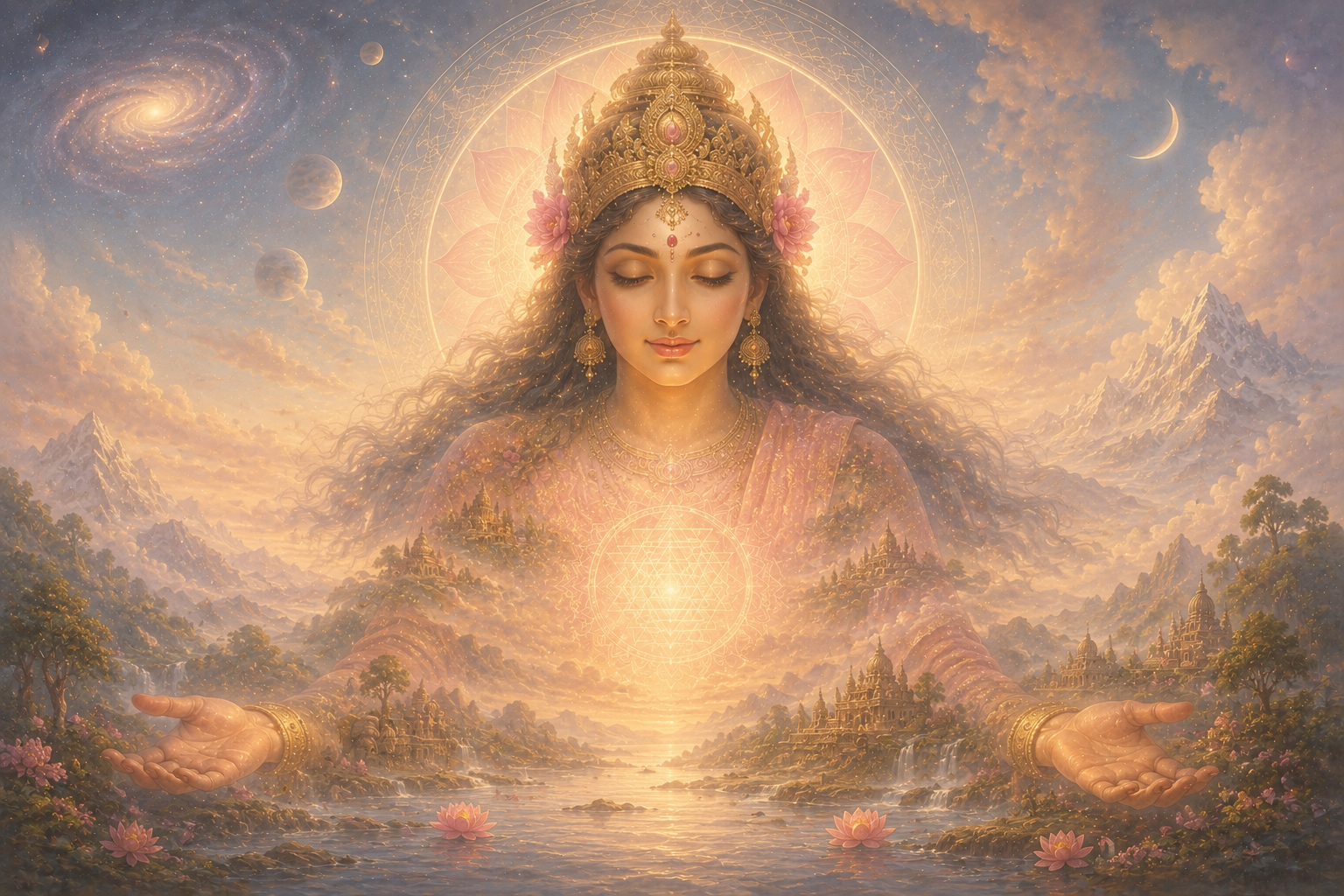
You may think that you are looking at her.
A radiant Goddess, red like the first light of dawn, seated upon the throne of Sri Nagara, holding a sugarcane bow, five flower-arrows, a noose and a goad.
You may see her at the Bindu of the Sri Chakra.
You may invoke her as Sri Mata, Lalita Tripurasundari, Rajarajeshwari, Kameshwari or Mahatripurasundari.
All of this is true.
But before asking who she is, Sri Vidya asks a far more unsettling question:
Who is looking?
- What is the light by which her form is seen?
- What knows that a thought has appeared?
- What witnesses the arrival and departure of waking, dream and deep sleep?
And when the mind becomes silent, what remains to know that silence?
The scriptures of Sri Vidya do not leave Lalita Tripurasundari safely outside us as one more divine object in the universe.
They gradually turn the entire act of worship back upon the worshipper.
The Bahvricha Upanishad (Bahvṛca Upaniṣad) declares that Mahatripurasundari is Pratyak Chiti (Pratyak-citi), the inward
consciousness, and that the one nondual Reality called Lalita Devi is the Supreme Brahman.
The Devi Upanishad (Devī Upaniṣad) places these words in the mouth of the Goddess herself:
अहं ब्रह्मस्वरूपिणी
Aham brahmasvarupini (Ahaṃ brahmasvarūpiṇī)
“I am of the nature of Brahman.”
The Tripura Rahasya makes the revelation even more intimate: the supreme Consciousness shines eternally as the unqualified
“I”, and the disciple is told:
“You are She, in the abstract.”
This article enters that mystery.
A note on sanctity: This study does not disclose initiatory mantras, their secret construction, or practices that traditionally belong
within Diksha and Guru guidance. Its purpose is to explore the philosophical and contemplative identity of Lalita Tripurasundari as revealed in scripture.
Entering the Mystery
- Who Are We Actually Asking About?
- Sri Vidya, Advaita and Kashmir Shaivism: A Necessary Distinction
- Before the First World Appeared, She Alone Was
- Why Is She Called Lalita?
- What Does Tripura Really Mean?
- The Goddess Who Remains When Your Worlds Disappear
- Turya: The Fourth That Is Not a Fourth
- Lalita Is Not an Object Within Consciousness
- The Goddess Who Is Looking Through Your Eyes
- From Witness to Shakti
- Prakasha and Vimarsha: Why Shiva and Shakti Are Never Two
- Why Is Consciousness Called Mother?
- Why Is She Called Sundari?
- Her Redness Is Not Merely a Colour
- Her Four Weapons Are Your Inner World
- Sri Chakra Is Not Only in Front of You
- Bindu: The Point at Which the Worshipper Disappears
- Lalita Sahasranama as a Map of Consciousness
- Where Is Lalita Tripurasundari?
- The Question She Leaves Behind
- Frequently Asked Questions About Lalita Tripurasundari
- Principal Scriptural and Scholarly Sources
Who Are We Actually Asking About?
When we ask, “Who is Lalita Tripurasundari?”, the question initially appears simple. We expect an answer similar to:
- She is a form of the Divine Mother.
- She is the presiding Goddess of Sri Vidya.
- She resides in Sri Nagara and at the Bindu of Sri Chakra.
- She is the consort of Kameshwara.
- She is worshipped through Mantra, Yantra, Puja and Dhyana.
All these answers belong to the tradition. But they describe only the first doorway. The deeper scriptures begin to dissolve the very assumptions hidden inside our question.
Ordinarily, when we ask who someone is, we assume three things:
- there is a person asking the question,
- there is an object to be known,
- and there is an act of knowing connecting them.
But the Bhavana Upanishad (Bhāvanopaniṣad) says that the non-difference of the knower, knowledge and the known is itself the worship of Sri Chakra.
The Lalita Sahasranama calls her:
Dhyana-dhyatru-dhyeya-rupa
(Dhyāna-dhyātṛ-dhyeya-rūpā)
She whose form is:
- meditation,
- the meditator,
- and that upon which meditation is performed.
It later calls her:
Jnana-jneya-svarupini (Jñāna-jñeya-svarūpiṇī)
She who is both knowledge and that which is known. The Goddess is therefore not merely waiting at the far end of the act of knowing. She is present as the seeker, the seeking and the sought.
This does not mean that every thought of the individual ego is divine wisdom. Nor does it mean that the ordinary personality should declare itself to be the supreme Goddess.
It means that the entire movement of experience is possible only because consciousness is already present. And Sri Vidya gives that consciousness a face, a name, a Mantra, a Yantra and the tenderness of a Mother.
Sri Vidya, Advaita and Kashmir Shaivism: A Necessary Distinction
Before going further, one distinction must be made carefully.
Sri Vidya, Advaita Vedanta and Kashmir Shaivism are not simply three names for one identical system.
They have different scriptures, histories, lineages, ritual worlds and philosophical methods. Advaita Vedanta often approaches the ultimate Reality by discriminating the unchanging Self from the changing body, senses, mind and states of experience.
The nondual Shaiva traditions of Kashmir give particular emphasis to consciousness as self-luminous, self-recognizing, free and inherently endowed with Shakti.
Sri Vidya reveals the same ultimate inquiry through the Divine Mother, Mantra, Sri Chakra, the union of Shiva and Shakti, and the progressive internalization of worship.
This article does not collapse these traditions into one.
Instead, the Shakta Upanishads – Tripura Rahasya, Lalita Sahasranama and Sri Vidya texts establish who Lalita is within her own tradition; the Mandukya Upanishad and Advaita help clarify waking, dream, deep sleep, Turya and the witnessing Self; the language of Prakasha, Vimarsha, Svatantrya and Pratyabhijna from Kashmir Shaivism provides a precise philosophical lens through which the inseparability of consciousness and its power of self-revelation can be contemplated.
The convergences are profound. The differences must also be respected. Authentic synthesis does not erase distinction. It allows one tradition to illuminate a mystery another tradition has expressed through a different sacred language.
The eight Shakta Upanishads traditionally listed in the Muktika collection are:
- Sita Upanishad (Sītā Upaniṣad),
- Tripuratapini Upanishad (Tripurātāpinī Upaniṣad),
- Devi Upanishad (Devī Upaniṣad),
- Tripura Upanishad (Tripurā Upaniṣad),
- Bhavana Upanishad (Bhāvanā Upaniṣad),
- Saubhagyalakshmi Upanishad (Saubhāgyalakṣmī Upaniṣad),
- Sarasvati Rahasya Upanishad (Sarasvatī-rahasya Upaniṣad),
- Bahvricha Upanishad (Bahvṛca Upaniṣad).
Not all eight speak directly of Lalita under the same name. The most direct foundations for this study are the Bahvricha, Devi, Tripura, Tripuratapini and Bhavana Upanishads. The other Shakta Upanishads deepen the larger theology of Devi as Prakriti, Sri, sacred Speech, knowledge, inner power and nondual Reality.
These are generally later, sectarian Upanishads rather than texts belonging to the earliest historical layer of Upanishadic literature. Their importance here is not that they prove the antiquity of every later Sri Vidya practice, but that hey are primary witnesses to how the Shakta and Sri Vidya traditions understood their own deepest reality.
Before the First World Appeared, She Alone Was
Most people imagine a Goddess as someone who appears after the universe has already come into existence. There is a sky, a world, a throne, a body and then a divine being seated within that world.
The Bahvricha Upanishad reverses this completely.
देवी ह्येकाग्र एवासीत् । सैव जगदण्डमसृजत् ।
Devi hy ekagra evasit; saiva jagadandam asrijat (Devī hy ekāgra evāsīt; saiva jagadaṇḍam asṛjat).
Before the manifested cosmos, Devi alone was. She brought forth the cosmic egg. The text then says that Brahma, Vishnu, Rudra, the celestial beings, all forms of life and everything that can be experienced arose from her.
The Devi Upanishad speaks in the first person:
मत्तः प्रकृतिपुरुषात्मकं जगत्
Mattah prakriti-purushatmakam jagat (Mattaḥ prakṛti-puruṣātmakaṃ jagat).
From me arises the world constituted of Prakriti and Purusha.
She then identifies herself with:
- bliss and its apparent opposite,
- knowledge and ignorance,
- the five elements and what is beyond the elements,
- the Veda and what lies outside the Veda,
- the born and the unborn,
- above, below and across,
- the whole universe.
This is not merely the claim that a powerful Goddess created matter at some remote beginning of time. The stronger claim is that no category remains outside her. She is not one cause among other causes. She is the ground from which the distinction between cause and effect itself appears.
The Saundarya Lahari gives this vision poetic force:
You are mind. You are space. You are air, fire, water and earth. Nothing remains beyond you. You transform your own Self into the body of the universe while retaining the form of consciousness and bliss.
The universe, in this vision, is not an object fabricated by Devi from material lying outside her. There is no “outside her.” The stars are not separate from her. The body is not separate from her. The mind that asks about her is not separate from her. Even the apparent experience of separation occurs within her immeasurable consciousness.
Before the first object appeared, she was. While every object appears, she is.When every object disappears, she remains.
Why Is She Called Lalita?
The Sanskrit name Lalita (Lalitā) carries the sense of the graceful, charming, tender and playful One. But the play of Lalita should not be confused with carelessness.
The Lalita Sahasranama calls her: Lila-vinodini (Līlā-vinodinī)
She who delights in divine play. Why would the Absolute play? Human action usually begins from incompleteness. We act because something is missing. We seek because we do not possess. We struggle because a goal lies elsewhere. But if Devi is Paripurna (Paripūrṇā), complete in herself, creation cannot be an attempt to repair a deficiency.
Seen from this contemplative perspective, manifestation is not the labour of an incomplete God. It is the freedom of fullness.
The Sahasranama calls her: Svatantra (Svatantrā)
The absolutely free One. It also calls her: Sarva-tantreshi (Sarvatantrēśī)
The sovereign of all Tantras.
The language of Kashmir Shaivism calls this absolute freedom Svatantrya: consciousness is not acted upon by something outside itself; its power of manifestation belongs to its own nature.
This does not prove that Lalita and the Trika concept of Svatantrya are historically identical.
But the philosophical resonance is illuminating. Lalita is the One for whom manifestation is effortless.
She becomes many without ceasing to be one. She appears as time without becoming trapped in time. She appears as every form without being limited to any form. She conceals herself within the individual and then, through Sadhana, reveals herself to herself. Her play is the play of consciousness appearing as the universe and then awakening within the universe to recognize its own source. The world may be her Lila. But the deepest Lila is this:
The infinite appears as a finite seeker who sets out in search of the infinite.
What Does Tripura Really Mean?
The name Tripura is often translated as “the three cities.”
But which three cities? The tradition does not offer only one answer.
Tripura can be contemplated through many triads:
- the three worlds,
- the three bodies,
- the three states of waking, dream and deep sleep,
- the knower, knowing and known,
- will, knowledge and action,
- subject, experience and object,
- creation, preservation and dissolution,
- past, present and future.
These correspondences should not all be treated as one grammatical etymology. They arise from different scriptural, ritual and commentarial contexts.
Yet they share one insight:
Every triad depends upon a unity that makes relationship possible.
The Bahvricha Upanishad says:
सैव पुरत्रयं शरीरत्रयं व्याप्य बहिरन्तरवभासयन्ती…
Saiva puratrayam shariratrayam vyapya bahir-antar-avabhasayanti (Saiva puratrayaṃ śarīratrayaṃ vyāpya bahir-antar-avabhāsayantī)…
She pervades the three cities and the three bodies, illuminating them within and without.
The Tripura Rahasya says that the one transcendental Consciousness overwhelms or transcends the three states and is therefore called
Tripura.
The Bhavana Upanishad turns the same mystery into Sadhana:
The knower is the sacrificer. Knowledge is the fire. The known is the offering. To contemplate their non-difference is Sri Chakra Puja.
Tripura is therefore not simply a Goddess who lives inside three cities. The three cities live within her. She is present as every member of the triad, as the relation joining them, and as the nondual ground in which all three arise.
The eye sees an object. The mind interprets what is seen. Consciousness knows both the object and the mental interpretation.
Where does one end and the other begin? What is the indivisible field within which
“I see this” becomes possible?
Sri Vidya calls that mystery Tripura.
The Goddess Who Remains When Your Worlds Disappear
In waking, a world appears: a body, a name, a history, relationships, duties, possessions, space, and time.
Then dream begins. The waking world disappears. Another body may appear. Another landscape arises. Other joys and fears become completely convincing. While dreaming, the dream does not announce itself as unreal.
Then deep sleep comes. The dream-world disappears. The dreamer disappears. The waking personality is absent. No object is presented.
Yet upon waking we say:
“I slept.”
Sometimes we add:
“I knew nothing.”
How is the absence of objects later known?
What continued while the waking person, dream person and their worlds vanished?
The Mandukya Upanishad (Māṇḍūkya Upaniṣad) analyzes these three states as:
- Jagrat (Jāgrat) — waking,
- Svapna — dream,
- Sushupti (Suṣupti) — deep sleep.
It then points toward Turya (Turīya), the nondual Self that cannot be reduced to any one of them.
The Lalita Sahasranama takes this Upanishadic inquiry and names the Goddess within it:
- Jagarini (Jāgariṇī) — she who is present as waking,
- Svapanti (Svapantī) — she who is present as dream,
- Taijasatmika (Taijasātmikā) — the inner luminous dream experiencer,
- Supta (Suptā) — she who is present as deep sleep,
- Prajnatmika (Prājñātmikā) — the deep-sleep consciousness,
- Turya (Turyā) — the Fourth,
- Sarvavastha-vivarjita (Sarvāvasthā-vivarjitā) — she who transcends every state.
This sequence is astonishing.
Lalita is not described merely as a deity who occasionally enters a practitioner’s meditation. She is identified with the very structure of experience.
When you wake, she is not absent. When you dream, she is not absent. When the mind and its worlds dissolve in sleep, she is not destroyed.
She is that through which the appearance, transformation and disappearance of all three states are known.
You have seen countless waking experiences. You have entered countless dreams. You have disappeared into sleep thousands of times. The contents have continuously changed. But the fact of consciousness has never been encountered as an external object. It is always the light in which encountering occurs.
That light, the Sri Vidya texts say, is Devi.
Turya: The Fourth That Is Not a Fourth
The word Turya (Turīya) means “the Fourth.”
But it is easily misunderstood. Turya is not a fourth experience that begins after waking, dream and deep sleep. It is not another temporary mystical state. It is not a blank trance that must be produced and then maintained.
The Mandukya Upanishad describes it through negation: It is neither outward-knowing nor inward-knowing. It is not a mixture of both. It is unseen, ungraspable, indefinable and beyond ordinary transaction. It is the essence of the awareness of the one Self.
शान्तं शिवमद्वैतम्
Shantam shivam advaitam (Śāntaṃ śivam advaitam).
Peaceful, auspicious and nondual. Why then call it the Fourth?
Because language counts it after the three states. But in reality, it is present throughout them. A screen does not become the fourth image after three images have appeared upon it. It was present before, during and after every image. Even this analogy is incomplete, because consciousness is not an insentient screen.
It knows.
The Tripuratapini Upanishad says that the one Self is to be recognized through waking, dream and deep sleep, and that the one who knows what transcends these three is freed from recurring identification.[4]
The Bhavana Upanishad makes the three states part of internal worship: The unification of the three states is the offering of Tambula. Turya itself is the prostration. This is no longer merely ritual symbolism. It means that the deepest prostration is the collapse of the limited identitythat imagines itself to be only the waking personality.
You do not enter Turya as a person entering a room. The person, the room and the act of entering are appearances within it. The Sahasranama therefore does not stop with Turyā.
It immediately calls her: Sarvavastha-vivarjita. She who is free from all states. She is called the Fourth only from the viewpoint of the three. From her own viewpoint, there has never been anything else.
Lalita Is Not an Object Within Consciousness
We normally know an object by turning attention toward it.
We see a lamp. We hear a sound. We remember a face. We visualize a deity. Whatever is known appears as something presented to consciousness. But can consciousness itself be presented in the same way? If consciousness becomes an object, what knows that object? And if another consciousness is required to know the first, what knows the second?
The regression cannot end by adding another observer. The Tripura Rahasya therefore insists that pure intelligence cannot be known as an ordinary object. It is that by which every object becomes known.
The Bahvricha Upanishad gives Lalita an extraordinarily precise name:
महात्रिपुरसुन्दरी वै प्रत्यक्चितिः
Mahatripurasundari vai pratyak-chitih (Mahātripurasundarī vai pratyak-citiḥ).
Mahatripurasundari is the inward consciousness.
She is not merely an object appearing before inward consciousness. She is Pratyak Chiti itself.
The Lalita Sahasranama echoes this through the names:
- Chit (Citiḥ) — consciousness itself,
- Chidekarasa-rupini (Cidekarasa-rūpiṇī) — homogeneous consciousness,
- Pratyak-chiti-rupa (Pratyak-citī-rūpā) — inward consciousness,
- Pratyag-rupa (Pratyagrūpā) — the innermost Self.
Does this make the visible form of Lalita unnecessary?
No.
Her form is a sacred doorway. The mind cannot immediately contemplate the unobjectifiable source of all experience. Therefore the formless assumes form. The unseen becomes visible. The incomprehensible becomes Mother. The infinite allows itself to be approached through a smile, a throne, a Mantra, a red lotus and the geometry of Sri Chakra.
But the form has fulfilled its deepest purpose only when it leads attention back toward the consciousness by which the form is known.
You may see a form of Lalita. The seeing itself is also her mystery.
The Goddess Who Is Looking Through Your Eyes
The title of this article must not be misunderstood. To say that Lalita is looking through your eyes does not mean that the personal ego, its opinions and its memories are the supreme Goddess. Nor does it mean that an anthropomorphic being is secretly sitting behind the eyeballs.
The eyes are instruments. In dream, the physical eyes are closed, yet an entire visible world appears. Therefore seeing cannot be reduced to the physical eye alone. The mind organizes perception. But the mind itself is known. Thoughts appear and disappear. Images arise and dissolve. Attention expands and contracts.
What knows these changes?
The Tripura Rahasya tells the seeker that the eye intended in inward inquiry is not merely the physical eye. It is the principle through which seeing and knowing become possible.
It then gives the teaching in its most direct form: The absolute Intelligence is eternally radiant as the pure
“I.”
You are She in the abstract.
Turn inward and recognize yourself as pure consciousness. This pure “I” is not the sentence
“I am this body,”
“I am this name,” or
“I am this history.”
Those are qualified identities. They arise in consciousness. The deeper “I” is the undeniable fact of being present before any qualification is added. Before you say what you are, you are. Before you describe experience, experience is already illuminated. Before you look at Devi, there is already the light by which looking is possible.
Sri Vidya gives that light the name: Lalita Tripurasundari.
The traditional Dhyana associated with Lalita Sahasranama contains the remarkable expression:
अहमित्येव विभावये भवानीम्
Aham ityeva vibhavaye Bhavanim (Aham ityeva vibhāvaye Bhavānīm).
A contemplative rendering is: “I contemplate Bhavani as the very I.”
The practice does not inflate the ego into divinity. It investigates the ego until the borrowed identities fall away and the light in which they appear becomes evident. The ego says:
“I see Devi.”
The Vidya asks: “What is the nature of the I by which seeing is known?”
From Witness to Shakti
A foundational step in Advaita inquiry is to recognize the Sakshi (Sākṣī), the witness.
The body is observed. Therefore the body cannot exhaust the nature of the observer. The senses are observed. Thoughts are observed. Emotions are observed. Even the sense of personal identity can be observed. What remains is not another object, but the witnessing awareness in which all objects appear.
This discrimination is essential.
But some modern presentations leave the witness as a passive, distant spectator, like an unmoving light that has no intimate relation to the world it illuminates.
The Sri Vidya sources do not leave consciousness lifeless.
The Lalita Sahasranama calls Devi:
- Mahapralaya-sakshini (Mahāpralaya-sākṣiṇī) — witness of the great dissolution,
- Parashakti (Parāśakti) — supreme power,
- Vimarsha-rupini (Vimarśa-rūpiṇī) — the form of self-reflective awareness,
- Viyadadi-jagat-prasuh (Viyadādi-jagat-prasūḥ) — mother of the universe beginning with space,
- Svatantra (Svatantrā) — absolutely free,
- Chitkala (Citkalā) — the living power of consciousness.
She is both witness and power. Silence and manifestation. The unchanging light and the capacity through which change becomes visible.
The Tripura Rahasya compares consciousness to a self-luminous mirror in which the universe appears without becoming separate from the mirror. The analogy must be handled carefully. An ordinary mirror is unconscious. It does not know the images reflected in it. Consciousness does.
Therefore Lalita is not merely the neutral background of experience. As Shakti, she is the capacity:
- to illuminate,
- to know,
- to recognize,
- to remember,
- to desire,
- to imagine,
- to manifest,
- to withdraw manifestation into silence.
The same Devi is the stillness before thought and the power by which thought appears.
She is the silence beneath language and the movement by which silence becomes sound. She is not merely the witness of creation. Creation is one of her gestures.
Prakasha and Vimarsha: Why Shiva and Shakti Are Never Two
Kashmir Shaivism offers two powerful terms: Prakasha (Prakāśa) and Vimarsha (Vimarśa).
Prakasha is the self-luminous nature of consciousness: the light by which anything is manifest. Vimarsha is consciousness’s inherent power of self-apprehension, self-recognition or awareness of itself.
Vimarsha does not mean ordinary intellectual reflection. It is more primordial than thought. It is the fact that consciousness is not merely light, but self-knowing light.
In the Pratyabhijna tradition, Shiva’s manifestation through Shakti is understood as an act of self-recognition. The universe is inseparable from that recognitive power.
Why does this matter for Sri Vidya?
Because Sri Vidya repeatedly refuses to separate Shiva from Shakti. The opening verse of the Saundarya Lahari declares:
शिवः शक्त्या युक्तो यदि भवति शक्तः प्रभवितुम्
Shivah shaktya yukto yadi bhavati shaktah prabhavitum (Śivaḥ śaktyā yukto yadi bhavati śaktaḥ prabhavitum).
Only when joined with Shakti is Shiva capable of manifestation; without her, he cannot even stir. At an outer level, this may sound like the union of a male God and a female Goddess. At the deepest level, it points toward an indivisible reality:
Consciousness and its power to know and manifest are never two.
Fire cannot be separated from its capacity to burn. Light cannot be separated from illumination. Consciousness cannot be separated from its capacity to reveal itself and its contents.
The Lalita Sahasranama therefore ends with:
Shiva-shaktyaikya-rupini (Śiva-śaktyaikya-rūpiṇī)
She whose form is the unity of Shiva and Shakti. It does not say that two eternally separate realities are temporarily brought
together. The name points toward their primordial non-separation.
The Bhavana Upanishad exists in variant recensions. In one transmitted passage, unconditioned consciousness is identified with Kameshwara, the full blissful Self with Lalita, and the universal redness of manifestation with Vimarsha.
This is one of the most profound bridges between Sri Vidya and the language of nondual Shaivism.
Shiva is Prakasha: the light of consciousness.
Shakti is Vimarsha: the power by which that light knows itself and appears as everything.
But these are not two substances. They are two ways of indicating one indivisible Reality. If Shiva were consciousness without Shakti, there could be no manifestation, no recognition and no experience. If Shakti were power without consciousness, she would be blind force.
Sri Vidya reveals the Absolute as both: luminous and alive, silent and creative, still and infinitely free.
Why Is Consciousness Called Mother?
The first name of Lalita Sahasranama is: Sri Mata (Śrī Mātā)
The Auspicious Mother. Why begin with Mother?
The tradition is not saying that Brahman possesses biological sex. Motherhood here is not a limitation imposed upon the Absolute. It reveals a relationship between the source and manifestation. A mother does not manufacture a child as an artisan manufactures an external object.
The child develops within her. It is nourished by her substance. It emerges from her while remaining inseparably related to her. Likewise, the Shakta scriptures do not present the universe as foreign matter assembled by a distant deity. The universe arises in Devi, is sustained through Devi, is known by Devi and returns into Devi.
The Bahvricha Upanishad says that she brings forth all living beings and the entire cosmos.
The Devi Upanishad calls her: Atma-shakti (Ātmaśakti) – The power of the Self.
It also calls her: Vishva-mata (Viśvamātā) – Mother of the universe.
The Sahasranama calls her:
Sri Mata — the Auspicious Mother, Jananī — she who gives birth, Viyadadi-jagat-prasuh — source of the universe beginning with space, Amba and Lalitambika — Mother Lalita.
Calling ultimate Reality Mother makes a metaphysical claim. Reality is not merely transcendent. It is intimate. It is not merely beyond the world. It is present as the life of the world. It is not merely a principle to be intellectually established. It can be loved, approached, surrendered to and discovered within. The word Mother also prevents nonduality from becoming emotionally barren. The source of existence is not an abstract emptiness indifferent to what appears within it.
In Sri Vidya, the source has the tenderness of compassion:
Avyaja-karuna-murti (Avyāja-karuṇā-mūrti)
The embodiment of causeless compassion. The universe is not orphaned matter. It is carried within consciousness.
Why Is She Called Sundari?
Sundari (Sundarī) means the Beautiful One. At the devotional level, her form is described as possessing incomparable beauty. But why would the ultimate Reality be called Beauty?
An ordinary beautiful object is one object among others. Its beauty depends upon form, proportion, colour, memory, culture and the mind of the observer. Lalita cannot be merely the most beautiful object in the universe. If she is the consciousness in which the universe appears, then even the experience of beauty depends upon her.
A flower is seen. A melody is heard. A face is loved. A mathematical pattern is recognized. A moment of silence feels complete. In every case, beauty is not merely a property lying inertly inside an object. It is a revelation occurring in consciousness.
The Sahasranama calls her:
- Paramananda (Paramānandā) — supreme bliss,
- Satyajnanananda-rupa (Satyajñānānanda-rūpā) — truth, knowledge and bliss,
- Samarasya-parayana (Sāmarasya-parāyaṇā) — established in perfect harmony or nondual equipoise,
- Prema-rupa (Premarūpā) — the form of love.
The deepest beauty is not decoration. It is the recognition of wholeness. Fragmentation appears ugly because each part seems torn away from the whole. When multiplicity is recognized as the expression of one consciousness, difference no longer necessarily implies separation.
Seen in this way, Tripurasundari is not simply “the beautiful woman of the three worlds.” She is the beauty through which the three worlds, the three states and every triad are gathered back into their hidden unity. She is beautiful as form. She is beautiful as the power of perception. She is beautiful as the silence into which perception dissolves. No object can contain her beauty, because every beautiful object shines within her light. She is not beautiful because the mind approves of her.
The mind recognizes beauty because a trace of her fullness has become visible through form.
Her Redness Is Not Merely a Colour
Lalita is repeatedly contemplated as red:
- red like vermilion,
- red like the rising sun,
- red like the hibiscus flower,
- surrounded by red radiance,
- immersing the universe in her own crimson light.
One of the opening names of Lalita Sahasranama is:
Nijaruna-prabha-pura-majjad-brahmanda-mandala (Nijāruṇa-prabhā-pūra-majjad-brahmāṇḍa-maṇḍalā)
She whose own red radiance immerses the entire cosmic sphere. This redness is not merely a description of complexion. In a transmitted passage of the Bhavana Upanishad, the redness of the whole is associated with Vimarsha, the self-revealing, self-aware dimension of consciousness.
Red is the colour of:
- life,
- blood,
- desire,
- warmth,
- creative power,
- the dawn before the sun fully appears.
As contemplative symbolism, Aruna can be seen as the threshold between the unmanifest darkness and the fully articulated world. It is consciousness beginning to glow as manifestation.
Prakasha is the light.
Vimarsha is the living awareness of that light.
Aruna is the universe blushing into appearance.
Her red radiance fills the cosmos because manifestation is not outside Shakti.
Every sensation, thought, form, movement and desire is already taking place within the field of her power. Her redness therefore contains both danger and grace. The same Shakti can bind as craving or liberate as recognition. The same energy can become compulsion or Sadhana. The same desire that turns outward in endless seeking can turn inward as the longing to know its source.
Lalita is red because consciousness is not sterile. It pulses. It desires. It reveals. It becomes worlds.
Her Four Weapons Are Your Inner World
Lalita holds four objects:
- a noose,
- a goad,
- a sugarcane bow,
- five flower-arrows.
These are often admired as part of her iconography. The Bhavana Upanishad reveals that they are also a map of the Sadhaka’s inner life.
It identifies:
- the mind with the sugarcane bow,
- the five Tanmatras, the subtle potentials of sound, touch,
form, taste and smell, with the five arrows, - Raga, attraction and attachment, with the noose,
- Dvesha, aversion, with the goad.
The Lalita Sahasranama gives the same sequence at its beginning:
Raga-svarupa-pashadhya (Rāga-svarūpa-pāśāḍhyā), Krodhakara-ankushojjvala (Krodhākārāṅkuśojjvalā),
Mano-rupekshu-kodanda (Manorūpekṣu-kodaṇḍā), Pancha-tanmatra-sayaka (Pañca-tanmātra-sāyakā).
The Goddess is therefore holding the entire machinery through which an individual experiences and reacts to the world. The mind is the bow. The senses release the arrows. Attraction binds. Aversion drives and wounds. The ordinary Jiva is continuously pulled by the noose and struck by the goad. A pleasant experience appears:
“I must possess it.”
An unpleasant experience appears:
“I must escape or destroy it.”
Between attraction and aversion, the mind is rarely free. But notice the icon:
Lalita Devi holds these powers. They do not hold her. This is the inner meaning of mastery. The senses need not be destroyed. The mind need not be hated. Desire need not be approached with fear.
Their place must be understood. When consciousness forgets itself, the instruments become masters. When consciousness recognizes itself, the instruments return to the hands of the Goddess.
Sri Chakra Is Not Only in Front of You
A Sadhaka may begin by placing Sri Chakra upon an altar. The lines are drawn precisely. The Avaranas are worshipped. The Devatas are invoked. Offerings are made from the outer enclosure toward the Bindu. This external worship is sacred.
But the Bhavana Upanishad makes a radical movement. It says that the body itself is to be contemplated as Sri Chakra. The body with its nine openings corresponds to the ninefold Chakra. The bodily constituents, Nadis, Pranas, senses, psychological tendencies and powers are mapped upon the Avaranas.
Kundalini is called Jnana Shakti. Iccha Shakti is identified with Mahatripurasundari. The knower, knowledge and known become the internal sacrifice.
This changes the meaning of Sri Chakra. It is not merely a sacred diagram representing a distant celestial palace.
It is also:
- a map of manifestation,
- a map of the body,
- a map of the senses,
- a map of the mind,
- a map of the powers that bind,
- a map of the return to the source.
The Tanmatras are not outside the Chakra. Your sensory world is one of its unfoldings. The Pranas are not outside the Chakra. Your breathing body is one of its movements. Desire, anger, memory, thought and discernment are not obstacles accidentally placed beside Sri Chakra. They are among the powers that must be recognized within it. The external Sri Chakra is therefore a mirror.
At first, you worship what appears to be outside. Then each enclosure begins to reveal something within. Finally, the distinction between the Chakra, the body, the cosmos and the consciousness contemplating them becomes increasingly difficult to maintain.
The Bhavana Upanishad calls sustained contemplation of this identity a path toward:
Devata-atma-aikya-siddhi (Devatātmaikya-siddhi)
The realization of the unity of the deity and the Self. This is why Sri Chakra cannot be understood through geometry alone. Its lines are not merely lines. They are the architecture of how the One appears as many and how the many recognize themselves as the One.
Bindu: The Point at Which the Worshipper Disappears
At the center of Sri Chakra is the Bindu. Geometrically, it is a point. Contemplatively, it is not small. A point has no measurable extension. Yet from the Bindu the entire Chakra becomes intelligible. It is the undivided center from which differentiation is contemplated. The Tripuratapini Upanishad calls the ninth enclosure: Sarvanandamaya Chakra
The enclosure consisting of all bliss. It is presided over by Mahatripurasundari and described as the most secret center.
The Lalita Sahasranama calls her:
- Bindu-tarpana-santushta (Bindu-tarpaṇa-santuṣṭā),
- Trikonaga (Trikoṇagā),
- Sri-chakra-raja-nilaya (Śrīcakra-rāja-nilayā).
But what does it mean to reach the Bindu? It cannot simply mean that an individual travels through a geometrical diagram \and arrives at the location where Devi is sitting. As long as the worshipper remains completely outside the Bindu, the center has not yet disclosed its deepest meaning.
The Bindu is where division has not yet unfolded into:
- subject and object,
- Shiva and Shakti,
- knower and known,
- inside and outside,
- worshipper and worshipped.
At the Bhupura, the Sadhaka approaches Devi. At the Bindu, the assumption of distance itself is questioned. Who has arrived? Where has the Sadhaka come from? Was the center ever absent from the one journeying toward it? The Bindu is not an object that the ego possesses at the completion of a ritual.
It is the point at which the ego can no longer maintain itself as an independent observer standing apart from Reality. The culmination of Sri Chakra worship is therefore not: “I have reached Devi.” It is closer to:
“The one who imagined separation was itself an appearance within Devi.”
The journey from Bhupura to Bindu is the journey from multiplicity toward unity. The more secret journey is from the worshipper toward the source of the sense of being a worshipper.
Lalita Sahasranama as a Map of Consciousness
The Lalita Sahasranama is often approached as a devotional hymn containing one thousand sacred names. It is certainly that. But when its names are read philosophically, an extraordinary architecture appears. The names move from the cosmic Mother, through the instruments of experience, into consciousness, the states of awareness, sacred Speech, the Self, Sri Chakra and finally Shiva-Shakti unity.
1. She Appears as the Cosmic Mother
- Sri Mata — the Auspicious Mother,
- Sri Maharajni (Śrī Mahārājñī) — the Great Empress,
- Srimat-simhasaneshwari (Śrīmat-siṃhāsaneśvarī) — ruler of the radiant throne,
- Chidagni-kunda-sambhuta (Cidagni-kuṇḍa-sambhūtā) — arisen from the fire of consciousness.
2. She Holds the Machinery of Experience
- the noose of attraction,
- the goad of aversion and anger,
- the mind as bow,
- the five Tanmatras as arrows.
3. She Is Consciousness and Bliss
- Chinmayi (Cinmayī) — consciousness itself,
- Paramananda — supreme bliss,
- Vijnanaghana-rupini (Vijñānaghana-rūpiṇī) — condensed, undivided awareness.
4. She Dissolves the Triad of Meditation
Dhyana-dhyatru-dhyeya-rupa
She is meditation, meditator and object of meditation.
5. She Becomes and Transcends the Three States
- Jagarini,
- Svapanti,
- Taijasatmika,
- Supta,
- Prajnatmika,
- Turya,
- Sarvavastha-vivarjita.
6. She Is the Inward Consciousness and the Stages of Speech
- Chit,
- Pratyak-chiti-rupa,
- Pashyanti (Paśyantī),
- Madhyama (Madhyamā),
- Vaikhari-rupa (Vaikharī-rūpā).
She is consciousness before language and the power through which unspoken meaning becomes audible speech.
7. She Is Self-Recognition and Manifestation
- Vimarsha-rupini — self-reflective awareness,
- Vidya — knowledge,
- Viyadadi-jagat-prasuh — mother of the universe beginning with space.
8. She Is the Witness and the Supreme Power
- Mahapralaya-sakshini — witness of cosmic dissolution,
- Parashakti — supreme power,
- Prajnanaghana-rupini (Prajñānaghana-rūpiṇī) — undivided consciousness,
- Matrika-varna-rupini (Mātṛkā-varṇa-rūpiṇī) — form of the sacred letters.
9. She Is Self-Knowledge
- Atma-vidya (Ātmavidyā),
- Mahavidya (Mahāvidyā),
- Sri Vidya (Śrīvidyā).
10. She Is Freedom, Consciousness and Love
- Svatantra — free,
- Chitkala — power of consciousness,
- Ananda-kalika (Ānanda-kalikā) — bud of bliss,
- Prema-rupa — the form of love.
11. She Is the Innermost Self
- Pratyag-rupa — inward Self,
- Parakasha (Parākāśā) — supreme inner space,
- Satyajnanananda-rupa — truth, knowledge and bliss,
- Samarasya-parayana — established in nondual harmony.
12. The Thousand Names End Where Duality Ends
- Jnana-jneya-svarupini — knowledge and known,
- Trikonaga — dwelling in the triangle,
- Sri-chakra-raja-nilaya — dwelling in Sri Chakra,
- Srimat Tripurasundari (Śrīmat Tripurasundarī),
- Sri Shiva (Śrī Śivā),
- Shiva-shaktyaikya-rupini — unity of Shiva and Shakti,
- Lalitambika (Lalitāmbikā) — Mother Lalita.
The Sahasranama therefore does not merely decorate a Goddess with a thousand attributes. It carries the Sadhaka: from form to consciousness, from consciousness to the states of experience, from the states to the inward Self, from the Self to Shakti, from Shakti to Sri Chakra, and from Sri Chakra to the indivisible unity of Shiva and Shakti.
The first name is Mother. The final name is also Mother. Between the two lies the entire universe.
Where Is Lalita Tripurasundari?
The scriptures appear to give many answers. She is in Sri Nagara. She is seated within the Chintamani palace. She is at the Bindu of Sri Chakra. She is present in Mantra. She is present in the Guru Mandala. She is in the heart-lotus. She is Kundalini. She is the body. She is the universe. She is the inward consciousness. She is Brahman. Are these contradictory locations?
Only if Lalita is imagined as a finite object that must occupy one place and exclude every other place.
The Tripuratapini Upanishad contemplates her in the heart as consciousness, Mahakundalini, Mahamaya and Tripura, yet also places her at the secret center of Sri Chakra.
The Bahvricha Upanishad says:
You,
I,
the universe,
all the deities,
and everything that appears are Mahatripurasundari.
It then declares:
सत्यमेकं ललिताख्यं वस्तु तदद्वितीयम् … परं ब्रह्म
Satyam ekam Lalitakhyam vastu tad advitiyam … param Brahma (Satyam ekaṃ Lalitākhyaṃ vastu tad advitīyam … paraṃ Brahma).
The one Reality called Lalita is nondual, indivisible Supreme Brahman. External worship is not negated by this teaching. The temple is not rejected. The Murti is not dismissed. Sri Chakra is not reduced to psychology. Rather, their hidden depth is revealed. The external form is the compassionate geometry of the formless. The Mother allows herself to be approached as an object because the mind does not yet know how to rest in the unobjectifiable.
The Sadhaka bows before her outside. The Sadhaka invokes her through Mantra. The Sadhaka contemplates her in Sri Chakra. The Sadhaka discovers her powers within the body. The Sadhaka recognizes her through waking, dream and sleep. Finally, the Sadhaka searches for the consciousness that knows all these movements.
There she is. Not as another experience. As that by which experience is possible. Advaita says:
Remove what is seen. Remove the changing body. Remove sensations. Remove thoughts. Remove every temporary identity.
What remains cannot be removed, because it is the light by which removal is known.
Sri Vidya whispers: That light is not empty of the Mother.
The Tripura Rahasya says: That which shines simply as “Is” is her Majesty, the absolute Consciousness. The universe is the Self, one without a second.
So where is Lalita?
Wherever existence appears. Wherever anything is known. Wherever love recognizes value. Wherever silence remains after thought. Wherever the sense “I am” shines before it becomes “I am this.”
She is not absent even from the thought: “I am far from Devi.” For that thought too appears in consciousness.
The Question She Leaves Behind
We began with a question: “Who is Lalita Tripurasundari?”
We searched before creation and found that Devi alone was. We searched within the universe and found that it was her manifestation. We searched the three states and found her as waking, dream, sleep, Turya and that which transcends all states.
We searched the act of meditation and found her as meditator, meditation and the object of meditation. We searched Sri Chakra and found the body, mind, senses, Pranas, desires and powers arranged within its Avaranas.
We searched the Bindu and found no place where the worshipper could remain eternally outside the worshipped. We searched for Shiva and Shakti and found Prakasha and Vimarsha: consciousness and its inseparable power of self-revelation.
We searched for the Mother and found the source from which every experience arises. e searched for Sundari and found the beauty by which anything can be experienced as beautiful.
Every step brought the inquiry closer to the one asking the question.
This is the secret reversal at the heart of Sri Vidya.
If Lalita were only an object, she could be found somewhere.
If she is the consciousness by which finding, seeking and knowing are possible, then the search must eventually turn toward the seeker.
This does not mean:
“My personality is God.”
The personality changes. Memories change. Beliefs change. The body changes. The sense of identity changes. Lalita is not the changing story. She is the light in which the story is told. You have never experienced a world outside that light. You have never encountered a thought outside that light. You have never known absence, silence or sleep outside that light. You have never actually stood apart from her in order to measure the distance between yourself and Devi. Perhaps she was never waiting at the end of the path. Perhaps she was the light by which the first step was seen.
You began by looking for Lalita Tripurasundari. The scriptures end by asking:
Who was looking?
And when the question becomes completely silent, what remains?
Sri Vidya gives that silence a name: Lalita.
Frequently Asked Questions About Lalita Tripurasundari
Who is Lalita Tripurasundari?
Lalita Tripurasundari is the central Divine Mother of the Sri Vidya tradition. At the devotional level, she is worshipped as the radiant Empress of Sri Nagara and the Goddess residing at the Bindu of Sri Chakra. At the highest philosophical level, Shakta Upanishads and the Tripura Rahasya identify her with inward consciousness, the Self, Shakti and nondual Brahman.
What does the name Lalita mean?
Lalita conveys grace, charm, tenderness and divine play. The Lalita Sahasranama calls her Lila-vinodini, she who delights in divine play. Philosophically, her play may be contemplated as the free manifestation of consciousness rather than an act arising from deficiency.
What does Tripura mean?
Tripura literally points toward the three cities, but the tradition unfolds the name through several triads, especially the three worlds, three bodies and the three states of waking, dream and deep sleep. She pervades these triads while remaining their nondual ground and transcendence.
Why is she called Sundari?
Sundari means the Beautiful One. She is not merely the most beautiful object within creation. In the nondual contemplation of Sri Vidya, she is the consciousness through which beauty, harmony, love and fullness are experienced at all.
Is Lalita Tripurasundari the same as Brahman?
The Bahvricha Upanishad explicitly declares the one Reality called Lalita to be nondual Supreme Brahman. The Devi Upanishad has the Goddess declare, “I am of the nature of Brahman.” This is the highest Shakta understanding; devotional, ritual and mythological levels of
worship remain valid within it.
Is Lalita the same as Parvati, Lakshmi or Sarasvati?
Sri Vidya texts associate Lalita with many forms of the Divine Feminine and present the various Goddesses as manifestations of one supreme Shakti. She should not, however, be reduced to only one later sectarian equivalence. In the highest Sri Vidya understanding, she is the consciousness and power through which all divine forms arise.
Why does Lalita hold a bow, arrows, noose and goad?
The Bhavana Upanishad identifies the sugarcane bow with the mind, the five arrows with the five subtle sensory potentials, the noose with attraction and attachment, and the goad with aversion. The icon therefore represents the inner structure through which human experience is formed and directed.
Where does Lalita Tripurasundari reside?
Scripture places her in Sri Nagara, the Chintamani palace, Sri Chakra, its Bindu, the heart and the inward consciousness. These locations are not necessarily contradictory. They express external, subtle, contemplative and nondual levels of the same Sadhana.
Is Sri Chakra the body of Lalita?
Sri Chakra is worshipped as her Yantra and as a geometrical revelation of her powers. The Bhavana Upanishad also maps Sri Chakra onto the body, senses, Pranas, Nadis, psychological tendencies and consciousness of the Sadhaka.
Does Kashmir Shaivism teach the worship of Lalita?
Kashmir Shaivism is a distinct nondual Shaiva tradition and should not simply be identified with Sri Vidya. Its concepts of Prakasha, Vimarsha, Svatantrya and recognition nevertheless provide a powerful comparative lens for understanding the inseparability of Shiva and Shakti expressed in Sri Vidya.
Is Lalita outside us or within us?
Sri Vidya begins with meaningful external worship and gradually reveals her within the body, Mantra, Sri Chakra and consciousness. The Bahvricha Upanishad identifies Mahatripurasundari as inward consciousness, while the Bhavana Upanishad describes the realization of deity-Self unity.
Principal Scriptural and Sources
- Bahvricha Upanishad (Bahvṛca Upaniṣad)
- Devi Upanishad (Devī Upaniṣad / Devy Atharvashirsha)
- Tripura Upanishad (Tripurā Upaniṣad)
- Tripuratapini Upanishad (Tripurātāpinī Upaniṣad)
- Bhavana Upanishad (Bhāvanopaniṣad / Śrīcakropaniṣad)
- Mandukya Upanishad (Māṇḍūkya Upaniṣad)
- Tripura Rahasya, Jnana Khanda (Tripurārahasya, Jñāna-khaṇḍa)
- Lalita Sahasranama (Lalitā Sahasranāma)
- Saundarya Lahari (Saundaryalaharī)
- Sita Upanishad,
- Saubhagyalakshmi Upanishad
- Sarasvati Rahasya Upanishad
- Primary Sources of Kashmir Shaivism and the Pratyabhijna Tradition
- Somānanda’s Shivadrishti (Śivadṛṣṭi)
- Utpaladeva’s Ishvara-pratyabhijna-karika (Īśvarapratyabhijñā-kārikā)
- Abhinavagupta’s Ishvara-pratyabhijna-vimarshini
- Tantraloka and Tantrasara; and Ksemaraja’s Pratyabhijna-hridayam (Pratyabhijñāhṛdayam).
- The Yogini Hridaya (Yoginīhṛdaya),
- Tantraraja Tantra (Tantrarāja Tantra)
- Nityashodashikarnava (Nityāṣoḍaśikārṇava) with Bhaskararaya’s commentary
- Vamakeshvara Tantra (Vāmakeśvara Tantra)
- Parashurama Kalpasutra (Paraśurāma Kalpasūtra)
- Nityotsava.
Research note: Many additional scriptures, traditional commentaries, books and scholarly studies were consulted in the preparation of this research article. The references listed above are those most directly relevant to its principal arguments.